Hoaxlines data analysis of Putin's approval rating alongside Russian aggression abroad affirms what other research has found. Putin's aggression abroad often reduces disapproval ratings and boosts approval ratings. hoaxlines.org/putins-approval-and-aggression-abroad
The rapid improvement in attitudes toward Putin and the lack of lasting consequences leaves an incentive for the Kremlin to repeat even ineffective tactics. The potential payoff is high. Maintaining power is a life-or-death matter for Putin today. But the rewards go beyond that.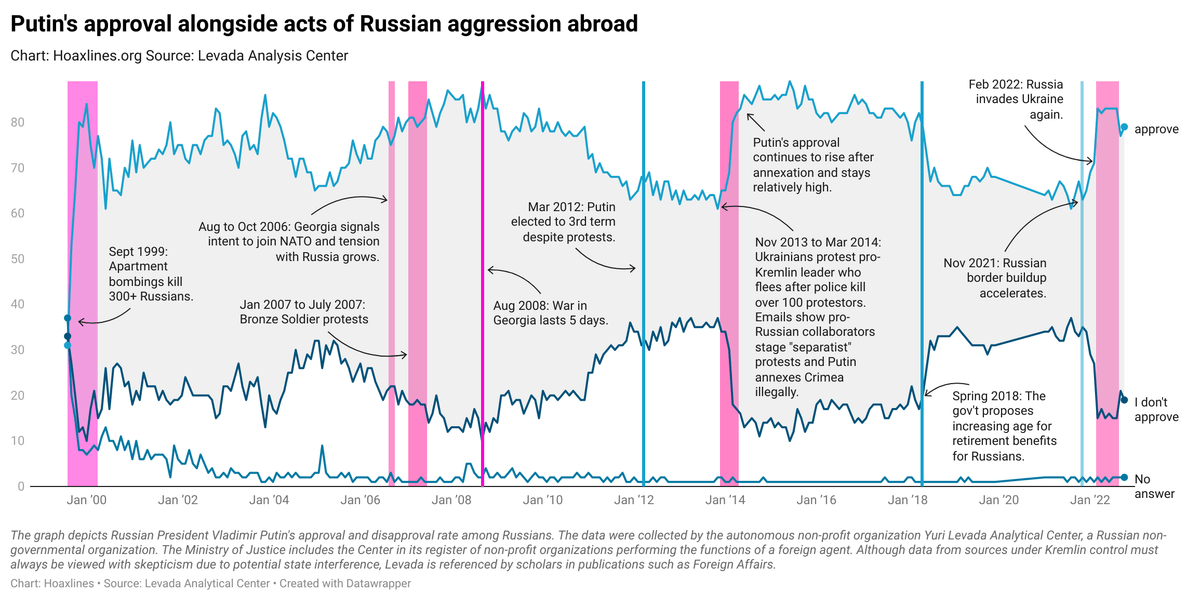
Presumably unintentionally-- NATO and Western countries have rewarded Putin for aggression if you assume the aim of Russian aggression is to delay accession to NATO. hoaxlines.org/putins-approval-and-aggression-abroad/citation-footnotes/the-feedback-loop-of-russian-aggression
Just as Putin has adapted to the system around him, NATO can too. NATO can respond to the current circumstances, which seem to incentivize these behaviors from multiple angles.
Here's how/why.
The boost in support associated with military action–if genuinely explained by it–is remarkable, lasting, and only seems to wane when Putin violates the unspoken norms of their social contract, as with raising the age for pensions or mobilizing them to fight in Ukraine.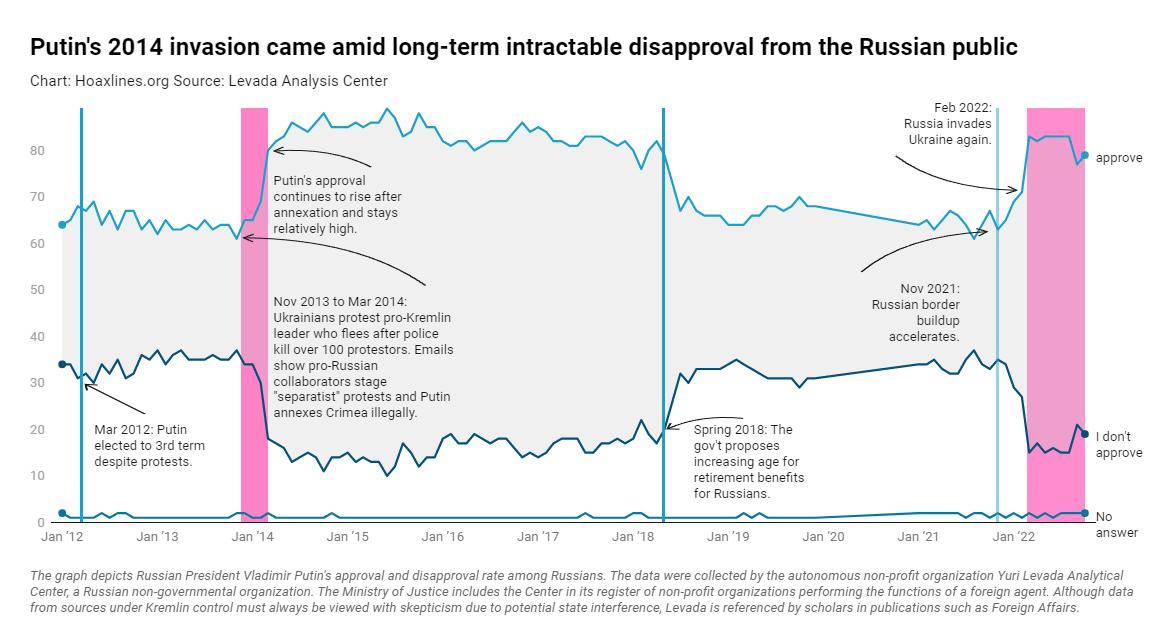
Policymakers who wish to deter Russia from what is now a well-worn series of tactics must tie undesirable actions to costs that the Russian people will perceive as violating Putin’s social contract with his subjects.
The public turns a blind eye to Putin's behavior and rampant corruption, but they expect a few things -- they expect a pension, of course. They also expect to be able to travel. 63% of Moscow residents have traveled abroad, according to the Levada Analysis Center.
Although many have claimed the public can't protest against the war, we see that they are willing to protest as they did in 2018 when the government considered increasing the age at which Russians receive their pensions. That's what caused the steep incline in disapproval.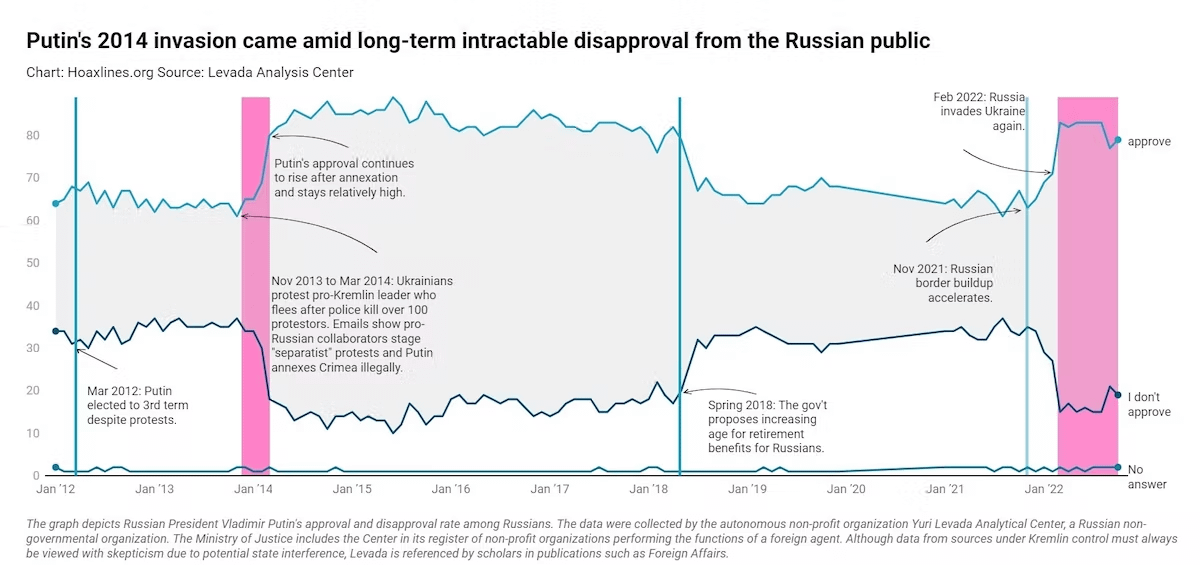
This is the feedback loop that appears when you look at data from 1999 to 2022. While some argue that new countries joining NATO somehow increases the risk of violence, no evidence supports this claim. Decades of evidence show the precise opposite.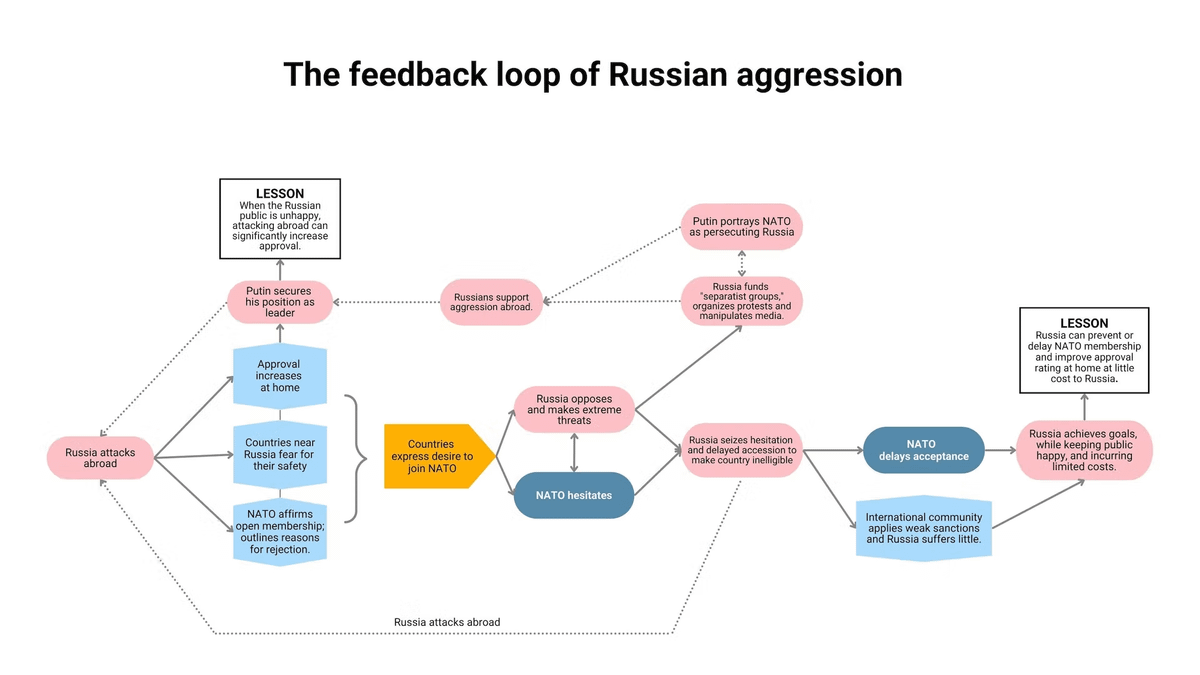
Still, we responded as if this was not the case. This is how other countries reward Putin. Here's a more concrete example. Russia’s behavior makes other countries want to join NATO by unleashing devastation in non-NATO countries while exercising restraint toward NATO countries.
The Second Chechen War was part of the motivation (easy to see why) for Georgia and Ukraine to join. Russia has never attacked or invaded a NATO country but has repeatedly attacked and invaded non-NATO states.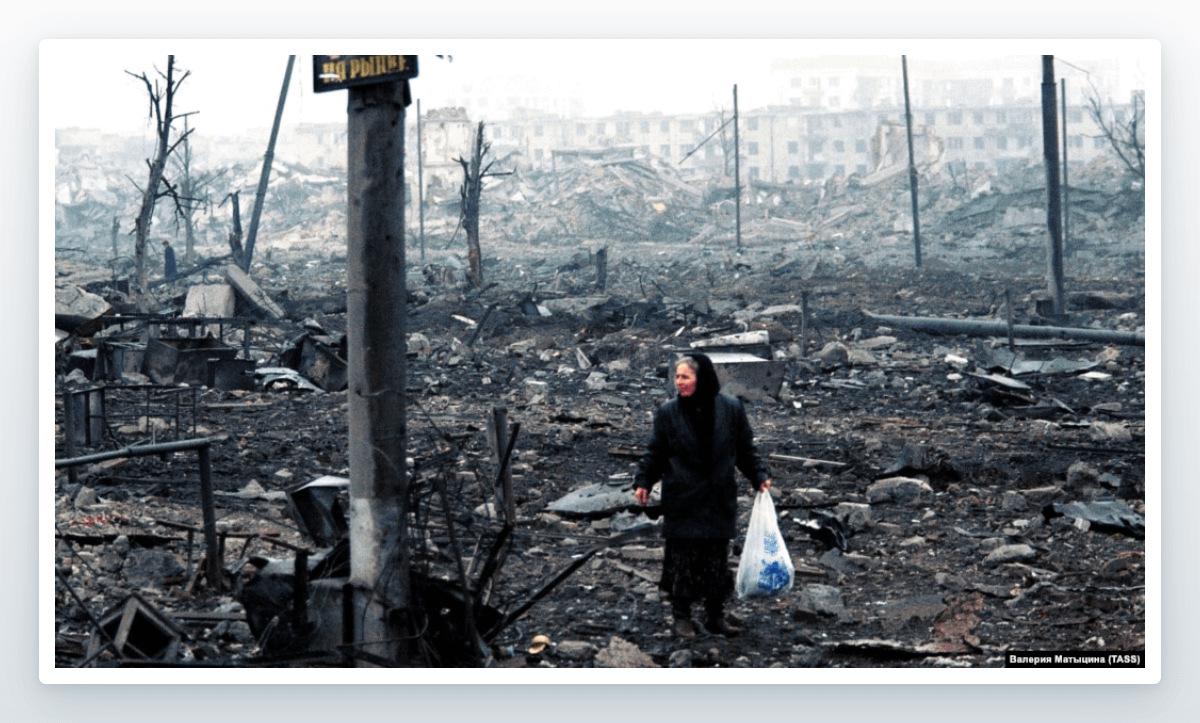
Jan 2006 - Leaked cables revealed that Russian intelligence was the prime suspect behind two Jan 2006 explosions on the Georgian-Russian pipeline. Another explosion the same day took down a high-voltage line based in Russia that supplied Georgia. washingtontimes.com/news/2010/dec/2/russia-waged-covert-war-on-georgia-starting-in-04/
Oct 2006 - The Georgian parliament votes unanimously for a bill to integrate Georgia into NATO. Kind of understandable. Russia warns Georgia against joining NATO. reuters.com/article/us-russia-georgia/russia-warns-georgia-against-joining-nato-idUSL213459120080221
Apr 2008 - Russia signs a treaty to defend Georgia separatists.
The war started on August 8, 2008, and was over in five days. Medvedev signs an order recognizing the independence of South Ossetia and Abkhazia, the two breakaway regions in Georgia. hoaxlines.org/putins-approval-and-aggression-abroad/fall-of-berlin-wall-to-2015-from-sen-hrg-114-130
Russia also bombed another pipeline. Or tried to, anyhow.
How did we respond?
reuters.com/article/us-georgia-ossetia-pipe/craters-show-russia-just-missed-georgian-pipeline-idUSLT54877120080829
We gave Russia what it wanted.
Nov 2008 - "The Bush admin. has supported putting the two former Soviet republics on a formal path...toward joining NATO. But there is considerable (EU) opposition, which has grown since Georgia’s war with Russia..."
reuters.com/article/us-nato-usa-members-idUSTRE4AP07A20081126
Nov 2008 - "NATO leaders promised 🇺🇦 and 🇬🇪...in April that they would one day join the Western defense alliance but declined to offer them the formal path toward membership because of 🇫🇷 and 🇩🇪 objections." Must be why 🇫🇷 and 🇩🇪 have sent so many weapons cnbc.com/2022/09/16/ukraine-slams-germany-for-failing-to-send-it-weapons.html
How did we respond when Putin invaded Ukraine in 2014? We gave him more of what he wanted.
June 2014 - Months after Putin illegally annexed Crimea, "NATO allies, led by 🇫🇷 and 🇩🇪, rebuffed 🇺🇸 demands that 🇬🇪 and 🇺🇦 be allowed" in.
Amazing.
reuters.com/article/us-nato-enlargement/nato-will-not-offer-georgia-membership-step-avoiding-russia-clash-idUSKBN0F00IJ20140625
June 2014 - "The United States, France and Germany were all reluctant to invite Montenegro to join now, believing the country still needs to carry out further reforms, diplomats said."
reuters.com/article/us-nato-enlargement/nato-will-not-offer-georgia-membership-step-avoiding-russia-clash-idUSKBN0F00IJ20140625
July 2014 - Know what happened a month later? Flight MH17 was hit by a Russian-made Buk missile and killed 283 passengers, including 80 children. 3 of the 4 people charged with the murders were Russian intelligence officers. bbc.com/news/world-europe-28357880
June 2017 - GRU officers attempted a coup in Montenegro (Remember how no one wanted to let them in bc it might make Russia mad?). A Supreme Court Justice of Montenegro said, “The organization aimed at preventing Montenegro’s accession to NATO.” warsawinstitute.org/russian-gru-agents-found-guilty-attempted-montenegro-coup/
Juxtapose this against what happens when NATO meets expressions of interest with a much shorter period between a decision/invitation and accession. With more time, it seems likely Russia might have attempted to dissuade Finland or Sweden.
Russia threatened nuclear retaliation if Sweden, Finland joined NATO (Also, yes, there are major differences between Ukraine and Georgia vs Sweden and Finland. Still, it's clear NATO needs to address the vulnerabilities and irrational behavior, which I'll discuss later).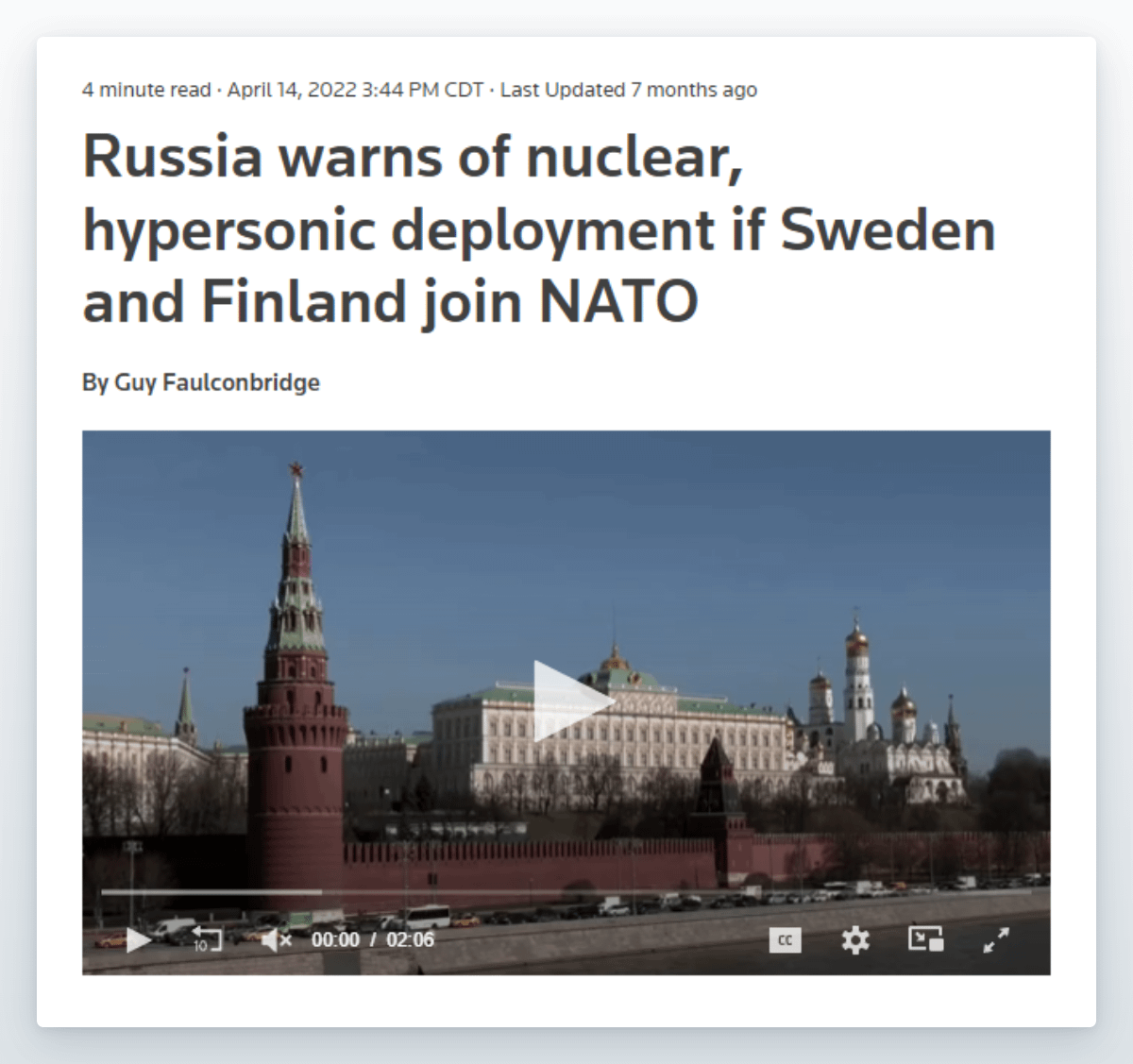
When Finland, Sweden joined, Russia pretended the situation made “no big difference," after using nuclear threats. The border between Russia and Finland is massive, yet Russia is sending troops away from NATO borders as if they know there's no threat. hoaxlines.org/putins-approval-and-aggression-abroad/citation-footnotes/russias-lavrov-says-finland-sweden-joining-nato-makes-no-big-difference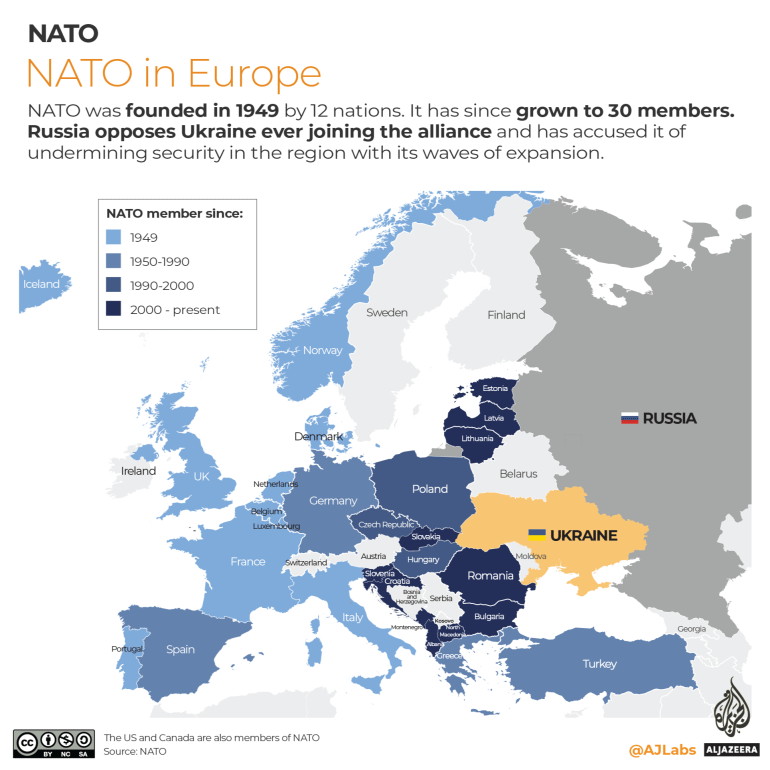
Nuclear threats have become something of a standard potential response to anything that offends Russia:
• 2008 - Putin issues nuclear threat to Ukraine over plan to host US shield theguardian.com/world/2008/feb/13/russia.putin
• 2014 - Russia simulating nuclear strikes on Sweden vice.com/sv/article/dpwk4q/why-is-russian-military-hanging-out-on-swedish-territory
• 2014 - Russia threatens nuclear strikes over Crimea thediplomat.com/2014/07/russia-threatens-nuclear-strikes-over-crimea/
• 2015 - Russia threatens to use ‘nuclear force’ over Crimea and the Baltic states independent.co.uk/news/world/europe/russia-threatens-to-use-nuclear-force-over-crimea-and-the-baltic-states-10150565.html
• 2015 - Russia threatens to aim nuclear missiles at Denmark ships if it joins NATO shield reuters.com/article/us-denmark-russia/russia-threatens-to-aim-nuclear-missiles-at-denmark-ships-if-it-joins-nato-shield-idUSKBN0MI0ML20150322
• 2016 - Russia threatens Norway with nuclear attack if it host 350 US Marines thelocal.no/20161031/norway-will-suffer-russia-makes-nuclear-threat-over-us-marines
• 2019 - Putin Threatens to Target U.S. if it Deploys Nuclear Weapons in Europe usnews.com/news/politics/articles/2019-02-20/putin-threatens-to-target-us-if-it-deploys-nuclear-weapons-in-europe
Russia understands the rules–though it doesn’t follow them–which is why it threatens countries’ territorial integrity. NATO must learn from the situation and find a path to membership that removes incentive and rewards for attacking potential members.
hoaxlines.org/putins-approval-and-aggression-abroad/feedback-loop-infographic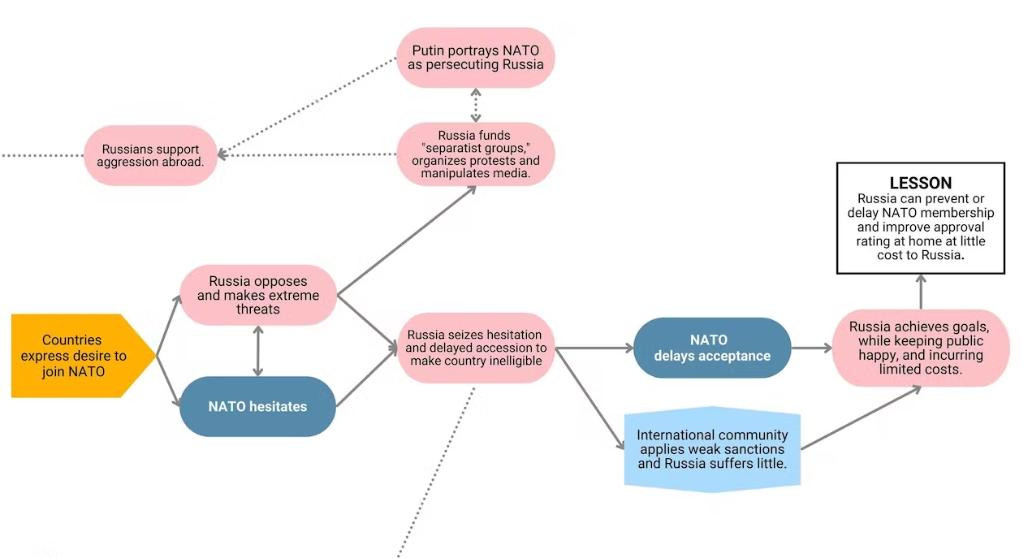
We see a grand promise: Anyone may join. When countries facing serious security threats, an obvious impetus for interest, express a desire to join NATO, their interest is often met with hesitation or delay, leaving them vulnerable to sabotage and military action from Russia.
NATO should become what it pretends to be: a defensive alliance that accepts those willing to meet requirements, even if they need help. It should stop allowing sabotage by taking years to accept potential members before saying, "Oh, well I guess you can't join."
This analysis brought one thing into sharp focus. Although other countries are not responsible for Putin's actions, they have failed to act based on evidence, and it has hundreds of thousands of lives--though not in the countries of the decision-makers. hoaxlines.org/putins-approval-and-aggression-abroad/fall-of-berlin-wall-to-2015-from-sen-hrg-114-130
The most effective responses may be those that cause Putin to violate the Russian social contract. Whatever NATO does, it should not continue rewarding Putin's behavior. NATO should not allow countries that don't pull their own weight to veto countries that would.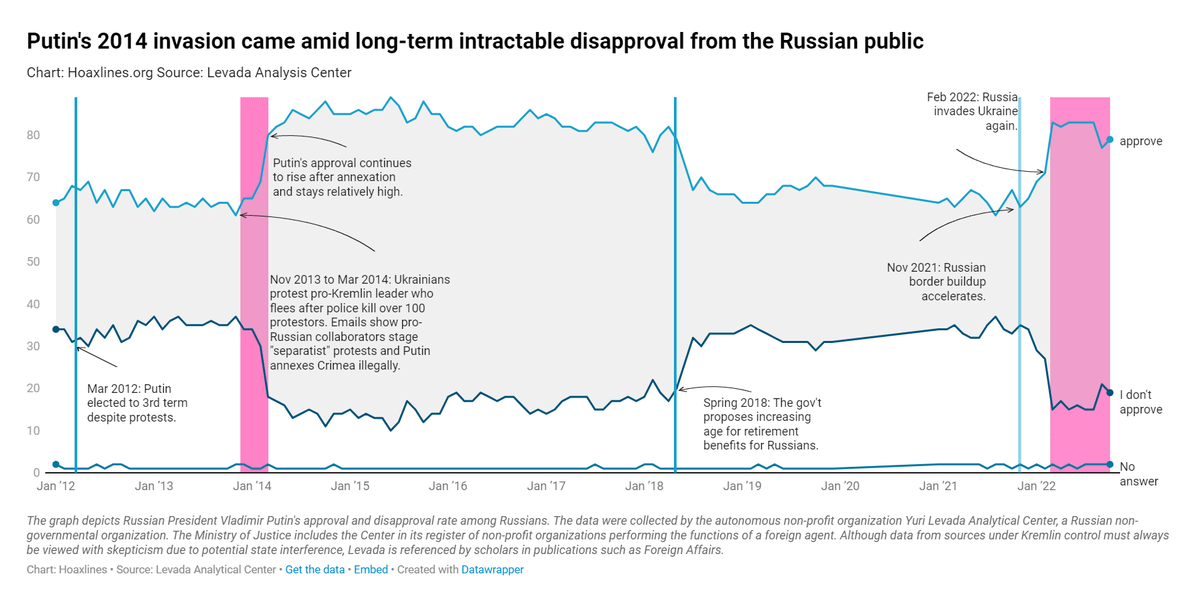
This is unacceptable, unethical, and exploitative. Members contributing nothing but pro-Russian takes instead of required contribution are the ones turning others away, using them like living buffers. If NATO wants to reduce Russian aggression, it should stop rewarding Russia.
No evidence suggests that admitting these countries back when the US first advocated for it would have led to anything more serious than it did when Finland, Estonia, Latvia, Romania, and so many others joined. The evidence does suggest we might have saved 100s of 1000s of lives.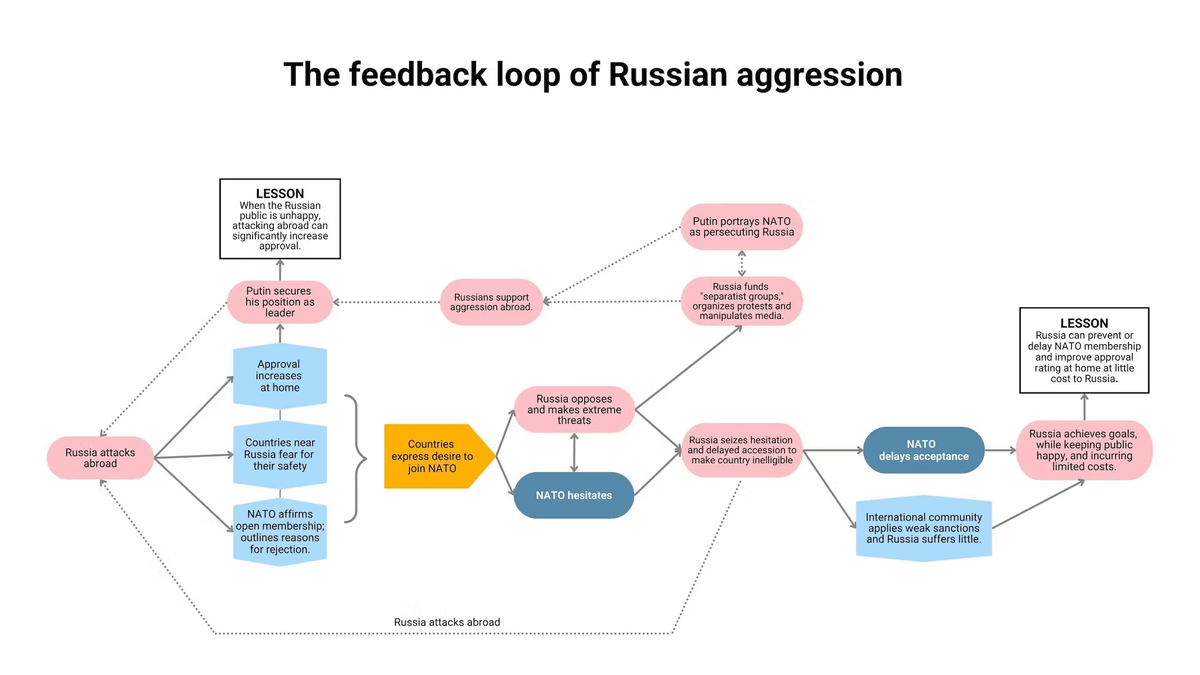
Links to all sources for this timeline can be found here: hoaxlines.org/putins-approval-and-aggression-abroad/timeline-of-putin-approval-and-aggression-toward-other-countries

E. Rosalie @erosalie.infoepi.com
@Info_Rosalie
Public health + national security • Johns Hopkins alum • Tracking mysterious weaponized pigeons and FIMI • Most likely building a database somewhere