Twitter recently discontinued its legacy account verification, which means users must establish their authenticity and credibility on the platform in other ways. Here are some ways you can attempt to do that. novelscience.substack.com/p/how-to-verify-your-twitter-account
List your Twitter handle on an official website.
For those with an official website, consider adding an explicit notice about your official Twitter handle on that site. This clear and visible statement will direct visitors to your genuine Twitter profile.
This is essentially how Mastodon verifies accounts. opensource.com/article/22/11/verified-mastodon-website users.
Cross-verify using an account on another platform.
Confirm your official Twitter handle through a verified account on another platform like Instagram or Facebook.
Although Facebook is expanding its verification as a paid service, they claim to only verify accounts that match the owner’s legal name. If you have a verified account on Facebook, you can mention your real Twitter handle.
Instagram’s verification policy, which is the same as Facebook’s because they have the same parent, no longer requires you to be “notable.” However, it does still verify that the person is who they claim to be.
Use the Internet Archive to show you were a legacy verified account. If your account was verified before the sale of Twitter, you can likely show that. While this method may not work for users who have changed their handles, it can help many formerly verified accounts.
Let’s use Christo Grozev, the founder of Bellingcat, as an example. Mr. Grozev is no longer verified on Twitter, but as Mr. Grozev has taught us, the internet is forever. An archive from early 2022, before the sale of Twitter, shows that he was a verified account.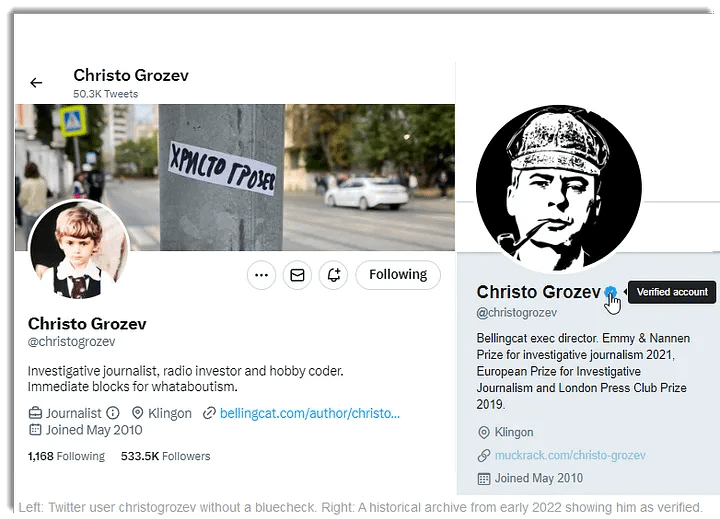
Mention your Twitter handle in content you create.
To help your audience identify your genuine account, include your Twitter handle in any content you create. For example, you can include it in the footer of your Substack newsletter.
Government agencies and elected officials are pretty good about this, so figures like that can be easily checked if they keep their information current. It’s not bad for other organizations to consider whether this would be appropriate because it can help prevent impersonation.
Share links to bylines or media mentions.
Link to old bylines, interviews, or profiles in the media where your Twitter account is listed alongside your profile. You can show that a credible third party has publicly associated a specific Twitter account with you.
Individual authors can link to content that includes their social media accounts. For example, I recently wrote an article published in Tech Policy Press. They included my Twitter handle in the author profile. techpolicy.press/autocrats-will-benefit-most-from-twitters-new-approach-to-state-affiliated-media/
Participate in live events like Twitter spaces.
This option won’t be for everyone, but speaking on Twitter spaces can offer reassurance if your audience knows your voice.
These aren’t ideal options, but they may help.
Always double-check the account you are engaging with if someone is behaving unusually or in any manner that might be deemed newsworthy.
We may be more likely to fall for a fake if we want to see what a bad actor is portraying. For example, if they are impersonating someone you don’t like in an unflattering light, you could be more likely to accept it unquestionably. nature.com/articles/s44159-021-00006-y#Sec2
Without official Twitter verification, there’s not much we can do that doesn’t require an additional step. Still, it may help someone catch a misidentification faster.

E. Rosalie @erosalie.infoepi.com
@Info_Rosalie
Public health + national security • Johns Hopkins alum • Tracking mysterious weaponized pigeons and FIMI • Most likely building a database somewhere