It's finally happened: you're going to manage other researchers.
But managing is much more than 1:1s.
Here are some non-obvious strategies to make the most of this transition:
1. Hiring earlier than you'd think
Managing can start with hiring.
But WHEN do you hire someone? When things are on fire...right?
If you see some internal red flags, you should actively begin hiring discussions.
Here are some signs to look out for:
- You've begun to turn down requests from partners because you're stretched too thin (or you rush through them as quickly as you can because you can't say no)
- Your backlog of "questions you'll get to one day" keeps growing with no end in sight
- You spend most of your time working IN the business (tactical, day-to-day operations) vs. ON the business (more strategic thinking about the future of your team)
- You're forced to become an expert in everything, with no time to specialize in anything
But identifying that you NEED to hire someone is only part of the effort.
You also need to persuade those that control the budget that this is a good investment.
Here are some ideas:
1. Lead with speed:
Having another researcher means you can learn more, go deeper, and move faster.
2. Start with freelancers and contractors:
If your org will allow it, bring on some outsourced help. The upfront cost is lower + you can assess them on output vs. a nice resume.
After you've hired someone, now the managing begins!
Well, not quite.
Even before someone starts, there are high leverage things you should be doing:
1. Document everything:
The curse of knowledge is real so document how research works at your org, key partners to consider, etc.
Pro-Tip:
Consider including video walkthroughs alongside your docs. It can bring workflows to life + new hires can review them 100's of times.
2. Context unlocks tools
Sharing the tools you use is good; HOW they all link together in your workflows is even better.
Pro-Tip:
Create a process map showing how and WHEN info moves between tools.
Ex: "Start in Zoom for interviews; move to Notion for the repo."
3. Be human
Remember when you were the new hire? How did you feel? What did you wish you knew both about the job + your company?
Turn your empathy inward and consider how the new hire is feeling and get ahead of it.
Pro-Tip:
Also, list what is NOT important at your org.
4. The J curve dip
The combo of you + the new hire actually produces less than you did before the hire because you’re now spending time training and onboarding them.
But given proper onboarding, they eventually generate their own output and you start to see the dividends.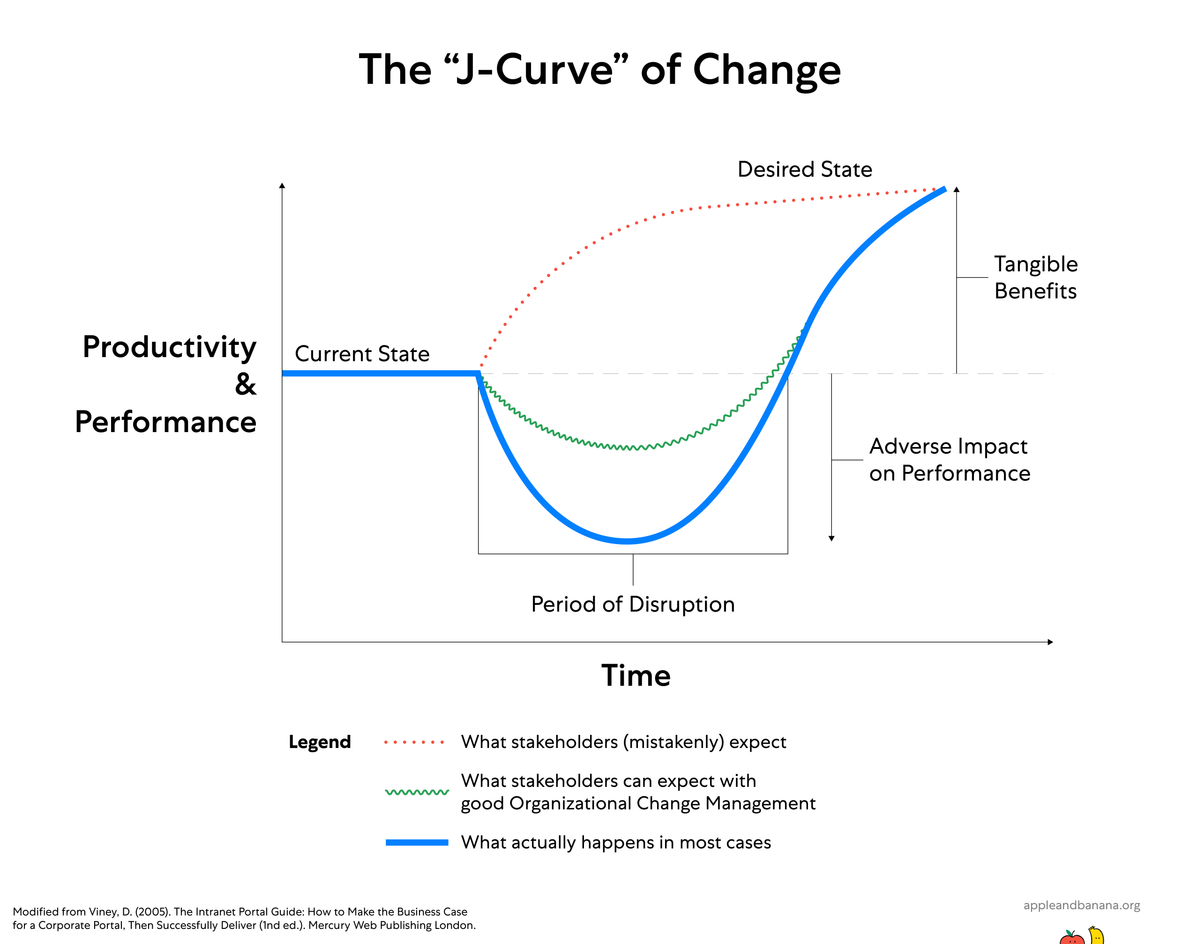
5a. 1:1s
After all of the above, NOW you can approach 1:1s.
A common cadence is a set time 1x/week for the first 12 weeks and then less frequently as it makes sense.
Pro-Tip:
Craft & share an agenda ahead of time. Center around the work, the workflows, and how you can help.
5b. More on 1:1s:
- Over time, they should be putting together the agendas. But that can happen about 4 weeks in, once they get a better handle on the role + the org.
- Set aside time to connect! Check-in on them beyond the role. Remember empathy for everyone, not just users.
6. The "1st 100 days" email
The day they start, start adding notes to a "Let's look back at your 1st 100 days here" email to be sent later.
Highlight the big projects they've worked on and any impact they've already made.
Pro-Tip:
Include fun stuff like # of emojis sent, etc.
7. Activate on needs
When they ask for help, don't just listen; actually, help them.
^Doing this consistently means you build trust faster.
Pro-Tip:
If real change is hard, still make a real effort + share context/updates. Sometimes that's enough.
8. Be nice to yourself
Managing isn't easy. Accept that you'll get things wrong. And that's ok!
All great relationships take time to build. View the bumps along the way as learning moments.
Pro-Tip:
If you can truly say "I tried my best whenever I could," that's a huge win.
Managing, like all skills, is a muscle that you have to build.
Hopefully, these tips help you strengthen that skill a bit faster.
You could also be an amazing manager and gift your team our upcoming book...
More info:
appleandbanana.org/bookwaitlist

Apple & Banana 🍎🍌
@AppleBananaUX
Explore our UXR knowledge base, used by 100s of research teams | Cofounded by ex-Facebook, SeatGeek, Techstars, Best Buy researchers 🍎🍌✌🏽