
NFTs may be entering this DEATH SPIRAL... 🧵
TLDR:
Speculative markets with reckless bullish behavior are highly susceptible to a crash.
A Minsky Moment is the tipping point where a quick decline in market sentiment leads to a crash.
The Otherside mint may be NFT's Minsky Moment and an unavoidable crash is ahead...
Hyman Minsky is a 20th century economist who studied the characteristics of financial crises.
His main economic theory is extended bull markets cause a disproportionate rise in speculation and end in epic collapses.
Speculative markets with heavy debt are the most at risk...
Minsky market cycles have 3 stages:
1. Minsky Boom (Hedge, Speculative, & Ponzi Finance)
2. Minsky Moment
3. Minsky Bust
The boom components are focused on increasing degrees of lending...
(I'll explain soon how this applies to NFTs...)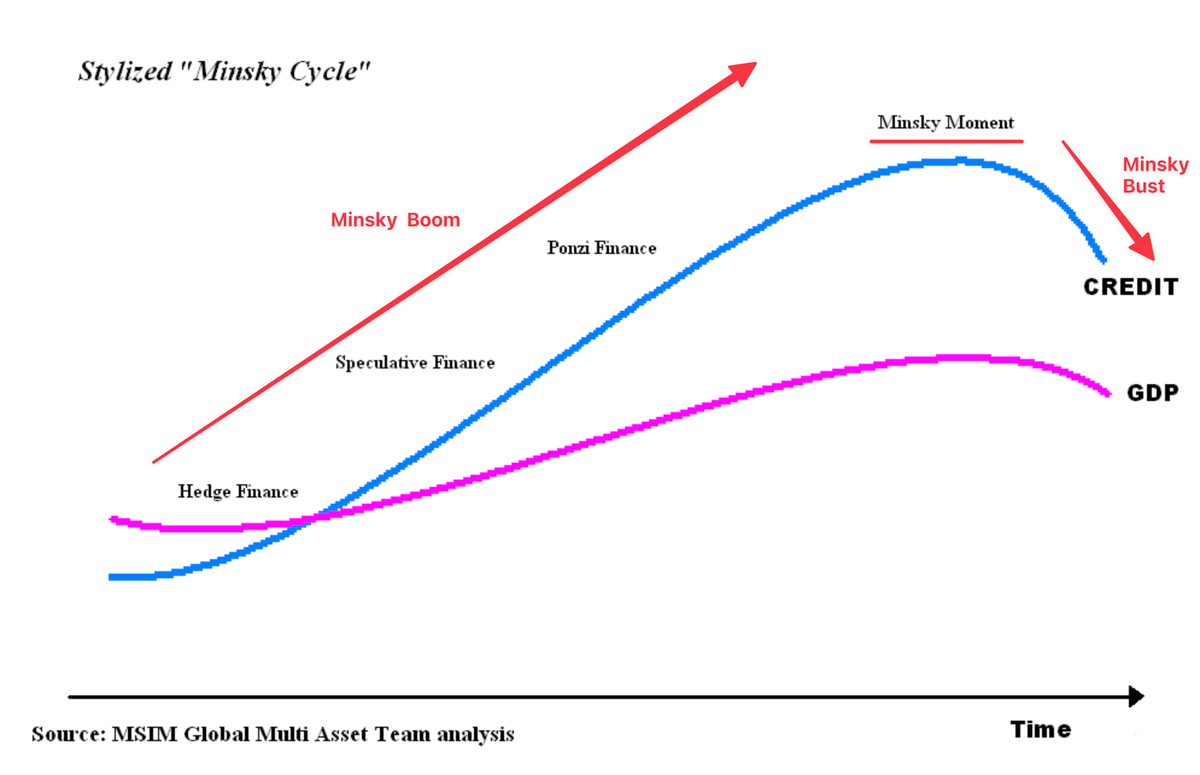
A Minsky Boom is when money rapidly enters a new market which boosts returns and decreases perceived risk.
There are three lending stages:
1. Hedge: holders can cover principal + interest
2. Speculative: only cover interest
3. Ponzi: cannot even cover interest — ppl buy to flip
There's a positive flywheel during the Boom where:
1. New capital enters
2. Returns 📈 & risk 📉
3. Market seems more attractive
🔄 Repeat the cycle until...
The flywheel spins too fast and prices become highly inflated which leads to a tipping point called a Minsky Moment.
A negative flywheel, Minsky Bust, then ensues where:
1. Capital leaves
2. Returns 📉 & risk 📈
3. Market seems unattractive
🔄 Repeat until asset prices decline to reflect their true risk:return.
NFTs don't initially appear to be eligible for Minsky cycles because...
NFTs have very little leverage and there isn't much institutional capital.
So, NFTs don't have margin call risk and LP redemption risk which typically attribute to Minsky cycles.
But... Minsky cycles usually occur in excessively bullish speculative markets like NFTs.
And...
We can replace over leveraged in the original model with these stage of personal overextending in NFTs:
1. Hedge: NFT investors put in what they're comfortable losing
2. Speculative: need some return but okay if prices decline
3. Ponzi: need to profit as they can't afford a loss
NFTs may have fallen into the core trap of Minsky's theory...
Capital inflows causing a disconnect between presumed risk and true risk which leads to a crash when corrected.
Eg, the Ponzi stage NFT investor may have incorrectly thought top NFT projects only go up...
Minsky moments are often preceded by declining alpha where people must invest more to earn equivalent returns.
We've seen this in NFTs with declining ROI and accelerated timelines.
For example...
Moonbirds cost 2.5 to mint and 8 on secondary, compared to 1/1.8 for Azuki and 0.08 for BAYC.
The time windows are narrowing with prices for top projects exploding after mint.
Eg, Moonbirds reached 35 ETH in days whereas it took Azuki and BAYC months.
twitter.com/punk9059/status/1517593301053894656?s=20&t=dlru98qSt0IZR8RM5LG8eQ
Investors must immediately put up 10x+ more $ to capture NFT alpha.
Interestingly... The perceived risk of top NFTs has declined over this timeline.
Buying Moonbirds at 8 ETH seemed "obvious" but minting BAYC for 0.08 ETH seemed "risky."
Even buying BAYC at 100 ETH seemed...
less risky as the market was more "mature."
But, what if things only seem less risky because more capital is being invested?
And risk is actually at its peak because prices are now inflated?
If you believe NFT risk AND return has decreased equivalently over time then the...
NFT market isn't susceptible to a Minsky Moment and Bust.
If not, like any great pyramid scheme, the market needs new $ to keep prices rising and the flywheel spinning.
Slowing capital inflows is enough to break the model...
Maybe ask yourself...
Do you think NFT capital inflows are slowing?
If not, do you think capital inflows are strong enough to outweigh the increase in NFT supply from new projects and airdrops?
Remember, Minsky cycles are never stagnant — the Moment is a tipping point between booming and busting.
FWIW, it looks like the Minsky Moment may have happened and the Bust is beginning.
The botched Otherside mint was the Moment and it's having a significant market impact.
Otherdeeds were the first time where a seemingly "sure bet" failed — the risk:reward was miscalculated.
As highlighted earlier, the Ponzi part of the NFT Minsky cycle is where people buy NFTs with the NEED of profiting.
The Minsky Moment is when the strategy becomes unprofitable... causing overextended investors to aggressively recoup any principle and brick floors in the process.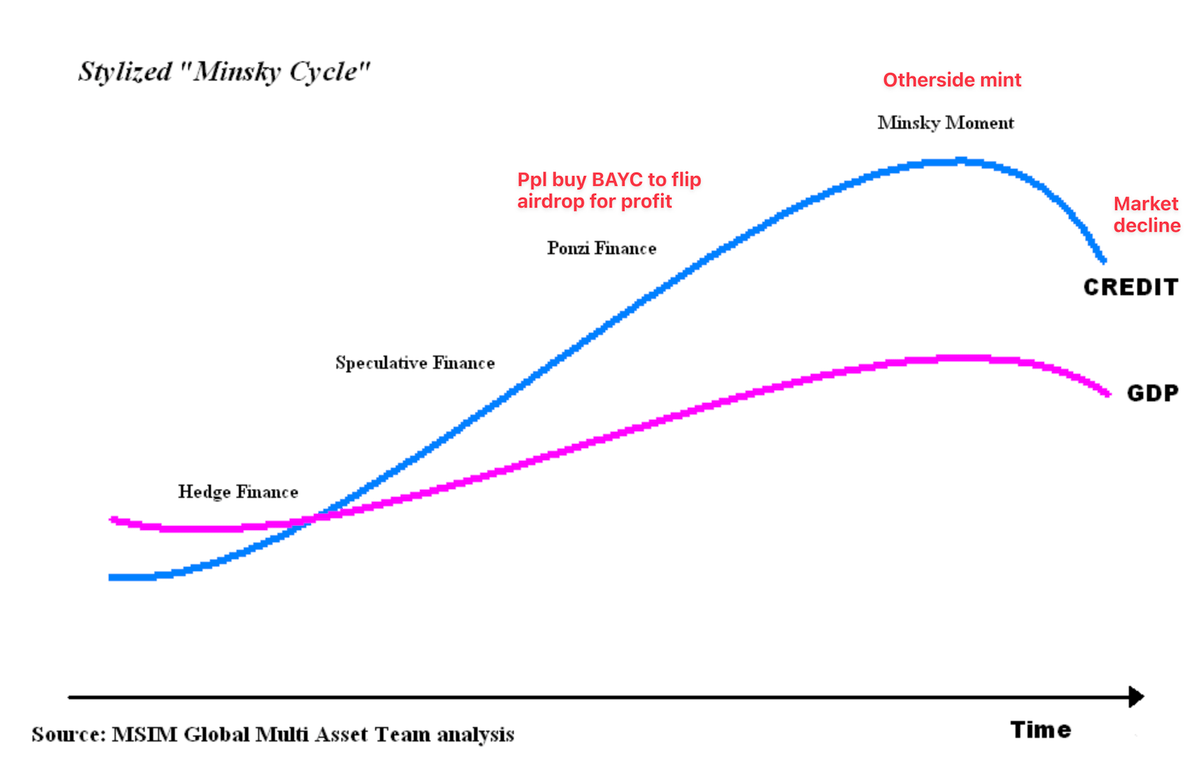
People are saying "BAYC crashed after $APE" but it's not true.
The collective value (BAYC + $APE) always outweighed the price of BAYC pre-airdrop and BAYC reached the same price within 2 days of the airdrop.
Whereas, the value of BAYC + Otherdeed is sitting FAR lower...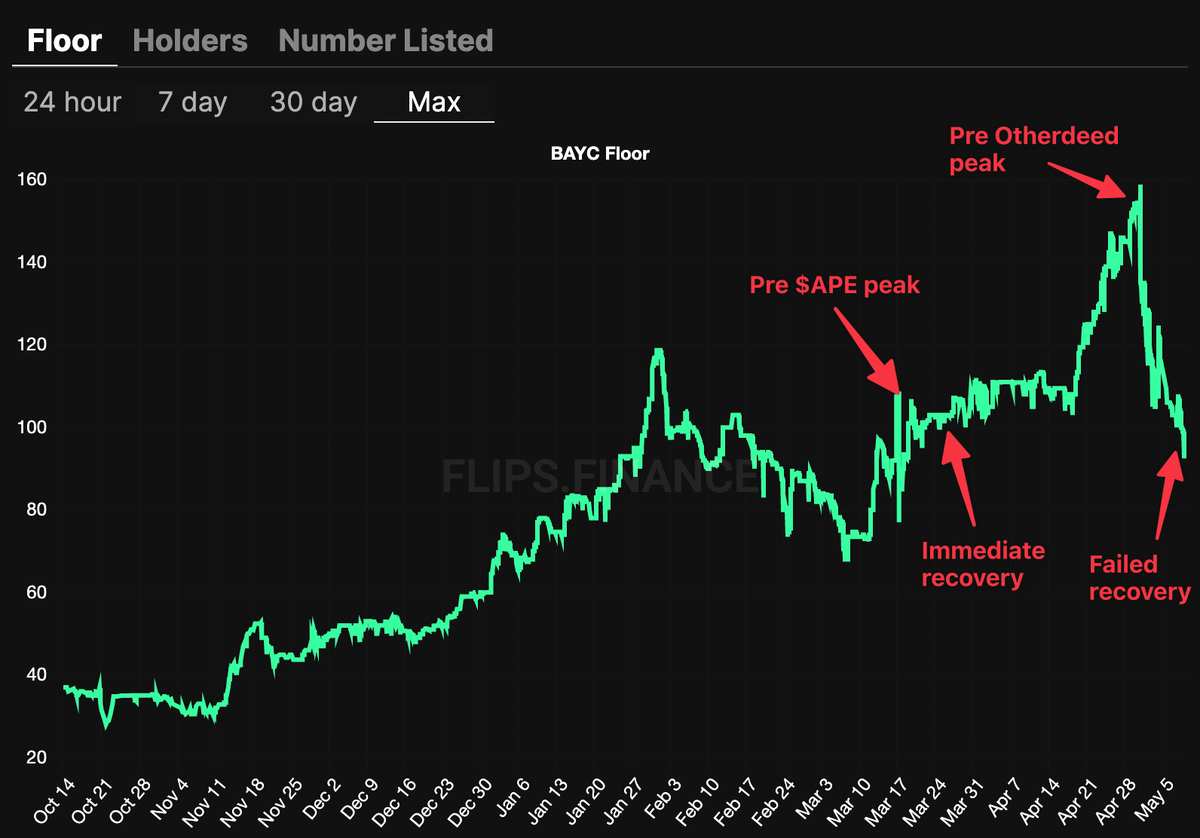
A decline in value post-airdrop also recently happened for quality projects like WoW, Vee Friends, DeadFellaz, and Alien Frens.
Returns are down significantly, especially when you factor in ETH's price, and the risk is FAR higher than it was months ago.
twitter.com/punk9059/status/1523429589774598147?s=20&t=SPnTS4e-CooyAOKrO9FTQA
NFTs have added risks in Minsky Busts because low liquidity and crazy volatility accelerate price movements.
We may see a DEATH SPIRAL ☠️☠️☠️
The last battle of NFTs where undercutters fight each other toward 0, killing all returns and scaring away any new liquidity.
Here are some NFT risk equation components and their highest risk progression:
· Listings 📈
· Floor price 📉
· Unique owners 📉
· Volume 📉
Astute buyers will steer away from a collection following this pattern...
But will they steer away from the market 👀 (see images)
"I'm nervous, wtf do I do?"
NFA but here's what I'm doing:
· Holding 65%+ of my portfolio in USDC
· Waiting to try to join in the 2nd inning of the next bull
The optimal tactic in a Minsky Bust is being the first person to exit as prices will continue declining.
We may not be in a NFT Minsky Bust and prices could *sustainably* jump back up.
I'd lose out in this case but I still prefer being risk off here given the macro uncertainty.
One thing to be weary of...
The most bullish investors won the bull market but bullishness will cost them in a bear market.
Many of these investors gained significant influence and it's important to be cognizant of whose opinions you're following...