Recently I lectured in Tokyo and Sydney about the American healthcare system. I was not proud to stand up in front of fellow ER doctors and say "So, here's how things operate in the US, and here are our outcomes to show for it." Below are my slides.
By background, I studied health policy in college. I worked on national health insurance before med school. (Hi @PNHP!) I've now been an ER doctor for 14 years.
I used to keep up closely with stats like "health spending by GDP" but I hadn't reviewed this data in a long time.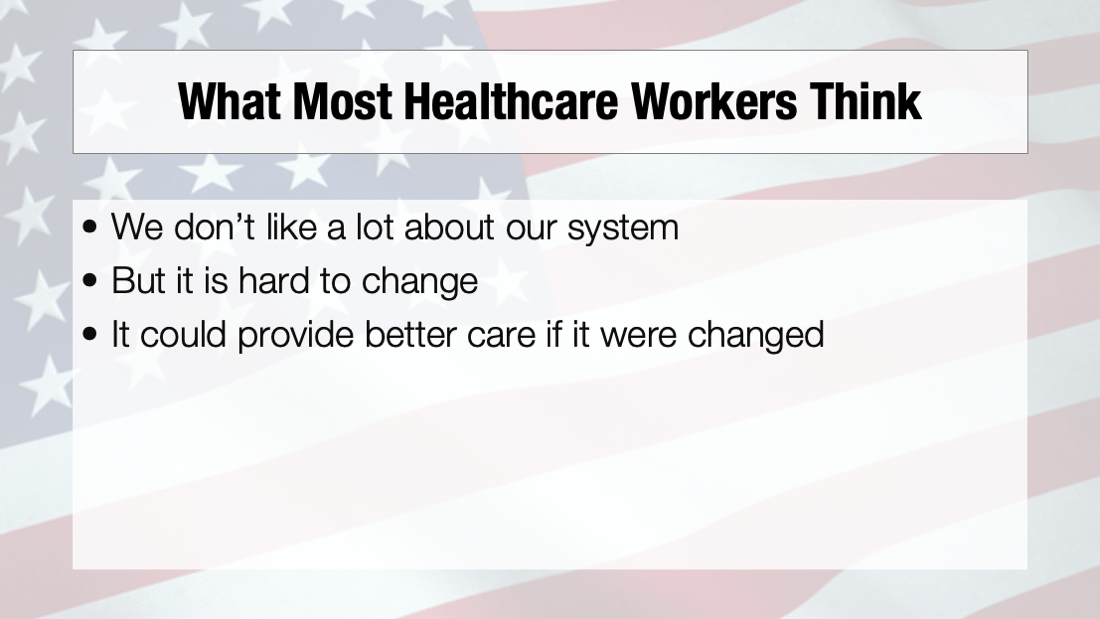
First off: It is not good when 1 in 5 doctors in your country does not trust the healthcare system that they themselves work in. We are pretty aware of how the sausage is made. If we don't trust our own system, the one that we "control"...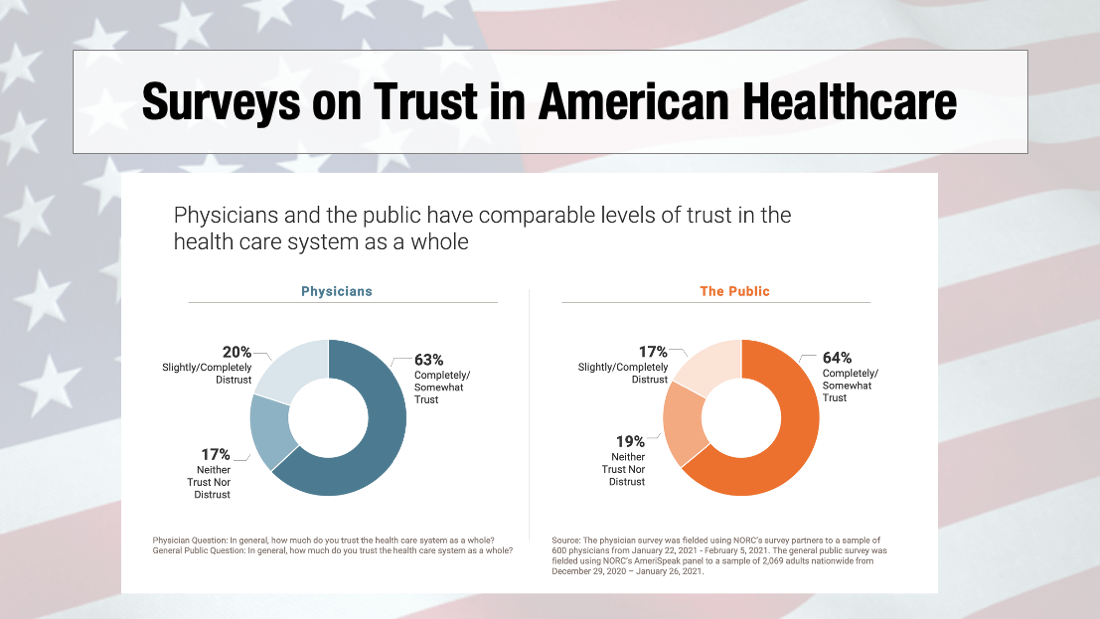
Like many things these days, Americans struggle to find clear agreement on how to solve problems. Healthcare is no different. We can't even agree if the government should ensure health coverage. (Which is interesting, because we're already paying enough for universal coverage.)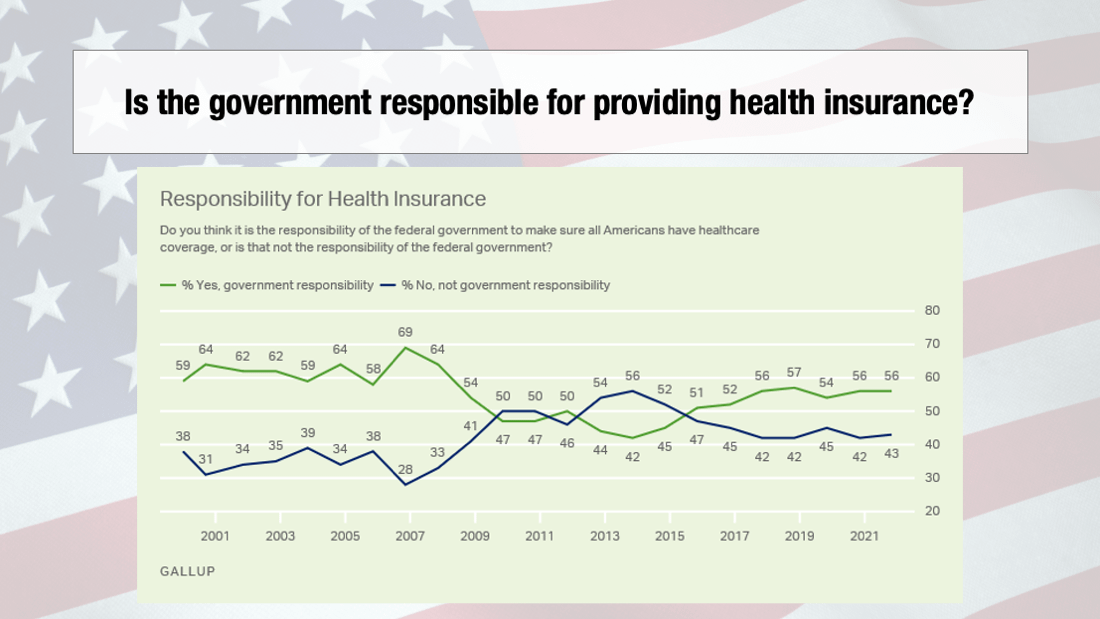
US healthcare is a BEAST. It would be the 4th largest economy in the world if it was a country. 20 cents of every dollar we make goes toward healthcare. (All of those other countries in the graph are able to somehow provide universal coverage for their citizens, but not us.)
We pour more and more dollars into healthcare each year, but are getting diminishing returns. (One of the reasons, I would argue, is the overly complex billing and administrative systems we've developed in order to "save money" and "control costs.)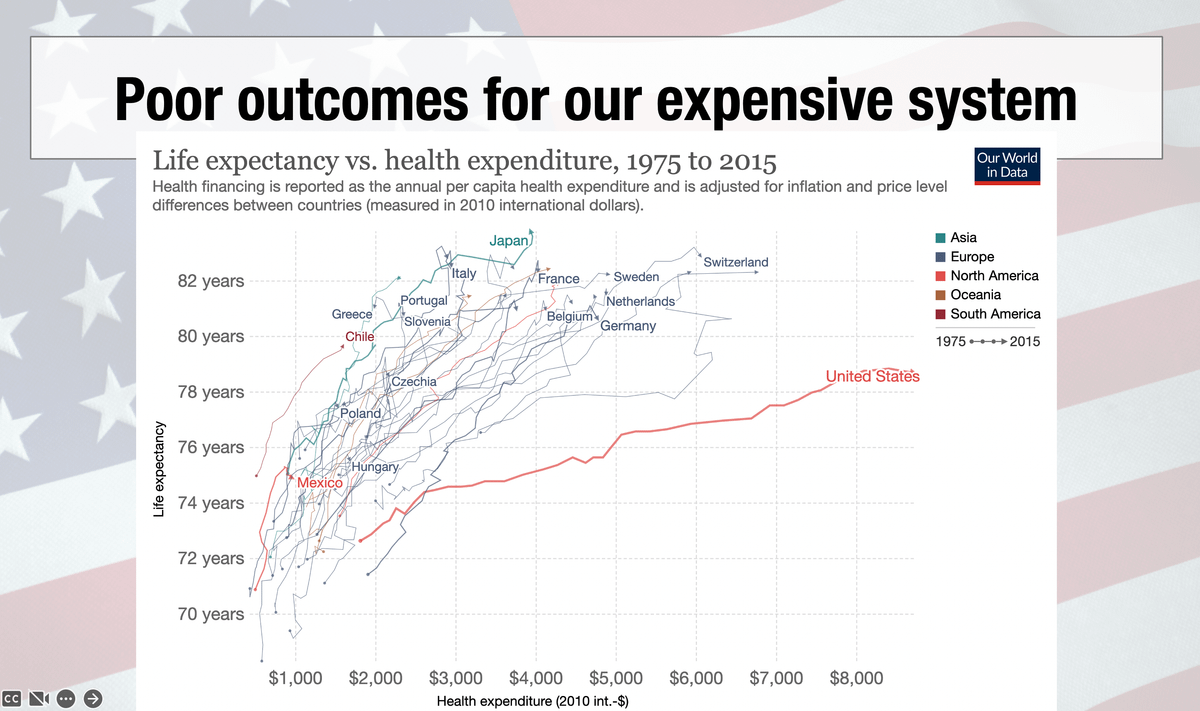
(Here's Japan and Australia's graphs for comparison, included since I lectured there. Also to point out for any "scary socialized medicine" types, both of these countries have private and public health insurance, and private and public hospitals.)
🇺🇸Back to the US. Part of the reason we're expensive is that our people have lots of disease. Hypertension, diabetes, heart&kidney disease. Americans are winning... at living lives WITH disease/disability than by most other countries. (Some of this is under our control, too.)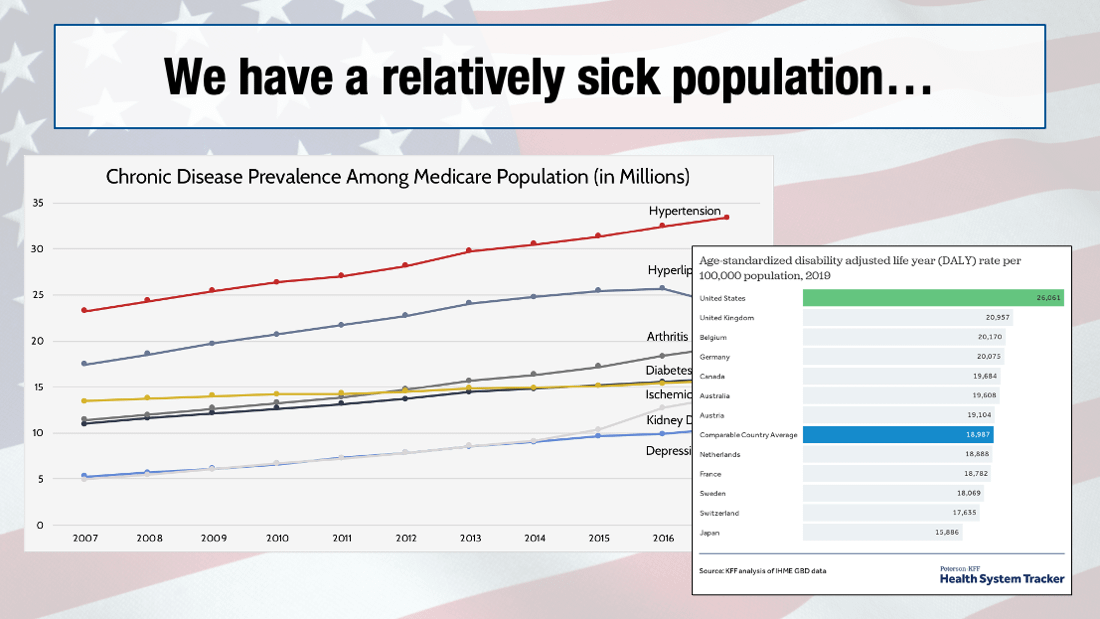
This slide is an abomination. While we're fighting about abortion in this country, our pregnant mothers have a 400% higher risk of dying than other developed countries. And our babies have a 70% higher risk of dying in the first year of their life. Before their first. Birthday.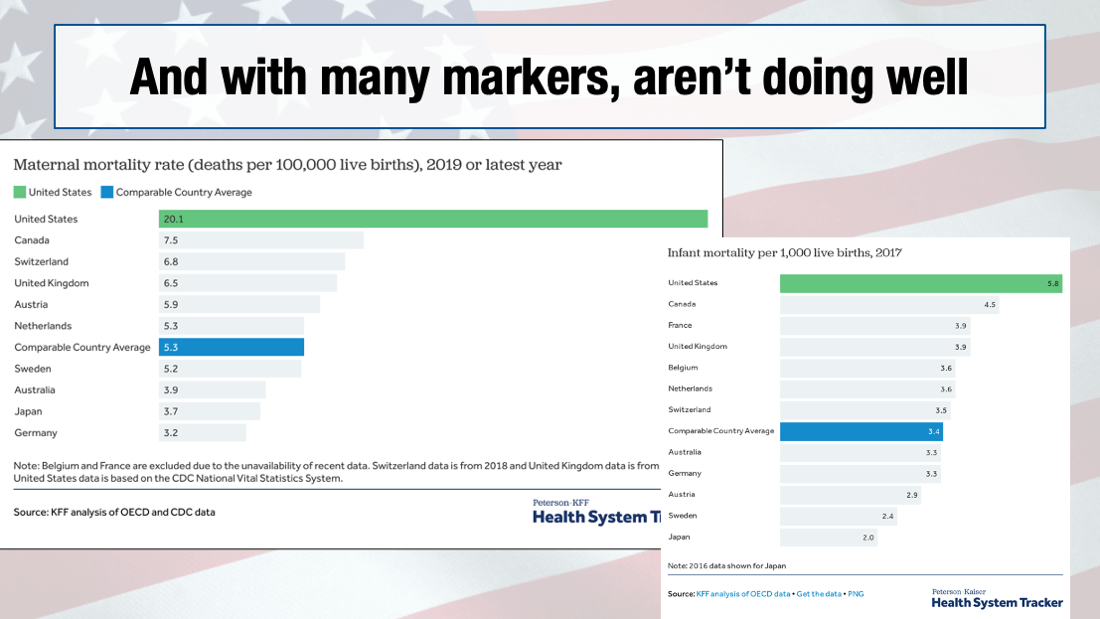
This is "years of life lost," comparing the US vs other countries. For many diseases, and conditions like accidents (which usually includes things like gun violence, traumatic injuries, suicides), your average American is more likely to die younger than they were supposed to.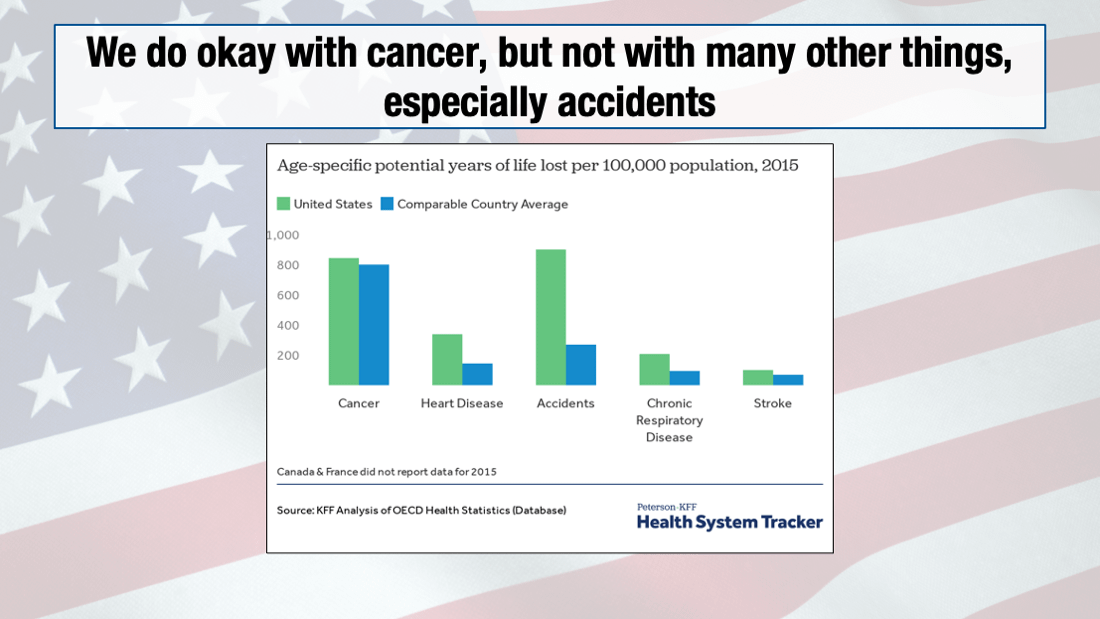
Once you get REALLY sick — sick enough for a heart attack, or require surgery, or have a stroke — the US healthcare system will full-throttle take pretty good care of you! I will see you in the ER and call a cardiologist at any time of day or night to come fix your heart attack!
But up until that point? Yeah, good luck. 1 in 4 Americans does not even have a regular doctor they could make an appointment with to get on some blood pressure medicine, or check their cholesterol level, or get their colonoscopy or mammogram.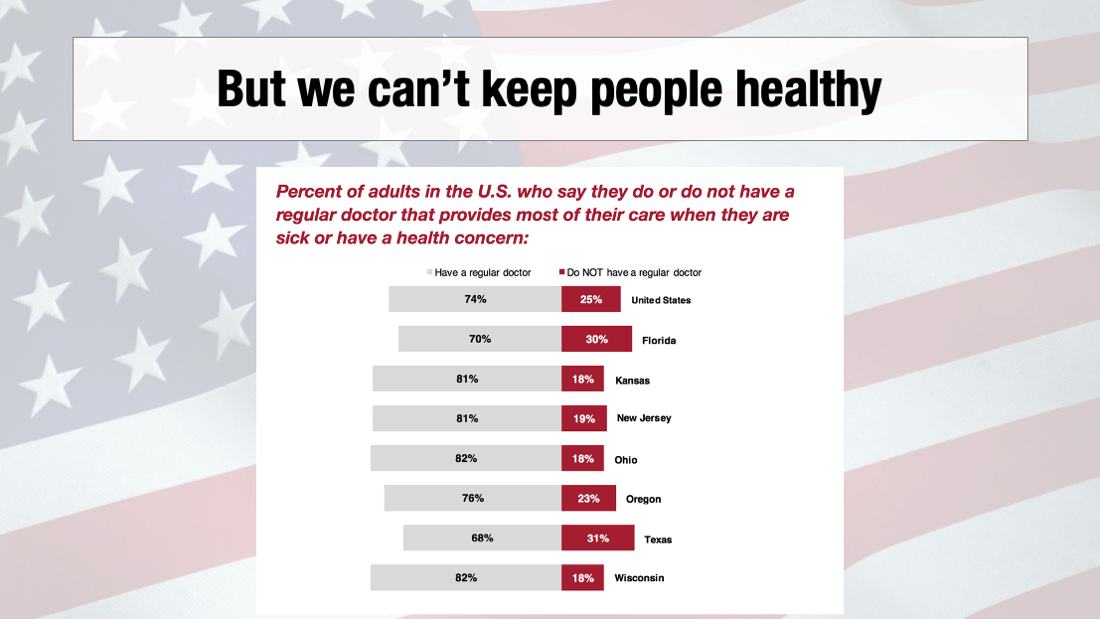
We pay a lot of money for fancy, expensive, invasive care like removing your colon if you have cancer, or opening your artery for a heart attack. But we'll barely pay anything for the "easy"-but-not-sexy stuff: blood pressure and diabetes control, exercise, stopping smoking.
("Easy" is in quotes there because there's pervasive flawed notion that primary care, provided by internists, pediatricians, OB-Gyns, and family practice doctors is "easy." It is anything but. If I could change only one thing, it might honestly be investing in primary care.)
You might look at this and think, "Hey, the US isn't doing so bad! We're almost as good as those other countries!"
Well, yes, Obamacare helped. But our 9.2% uninsured in the US? That's 31 MILLION PEOPLE.
(And I'm not even touching the concept of "under-insured.")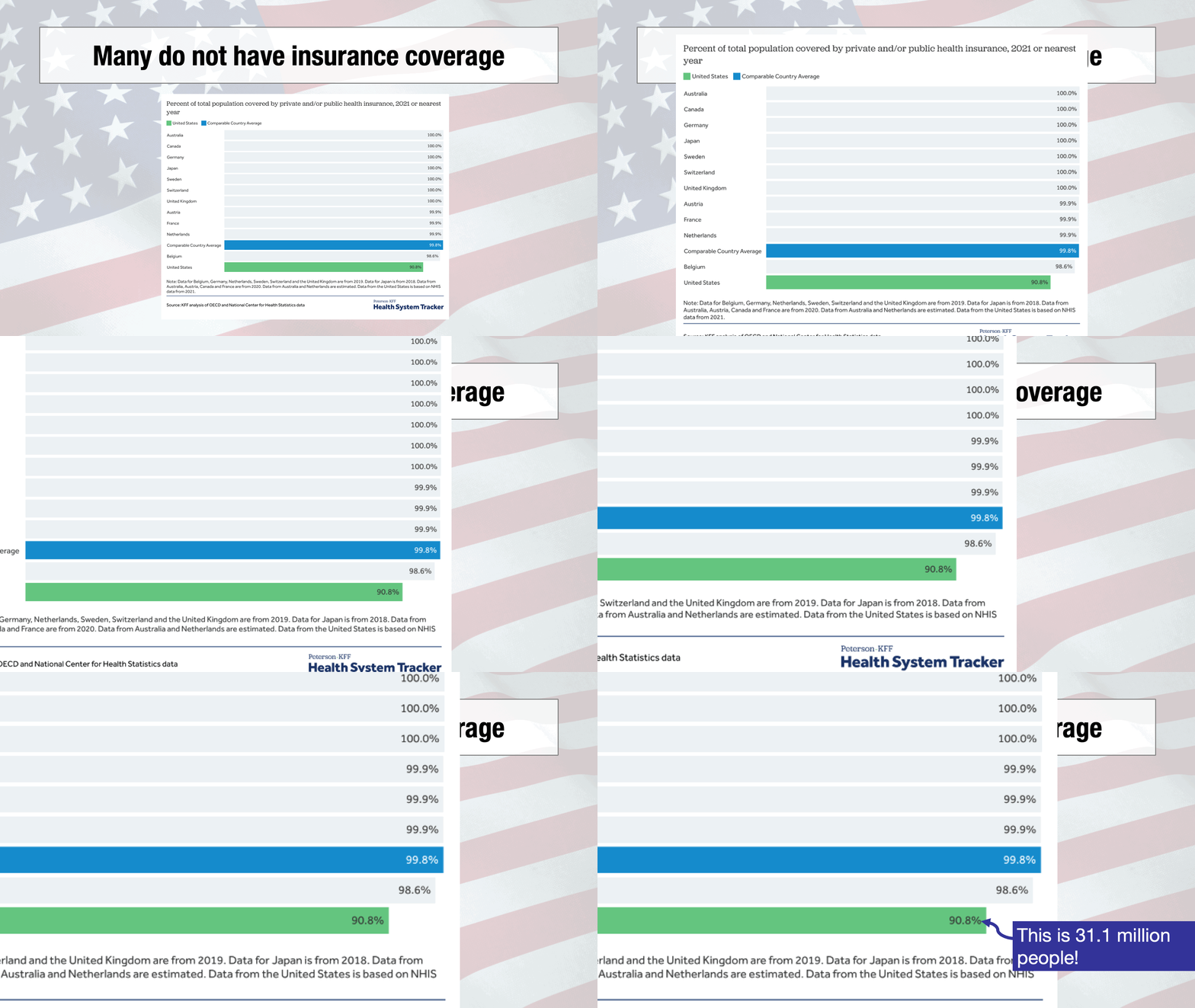
I couldn't really come up with a better definition for the US healthcare system than "a complex mess." I can't find the study, but for example one metropolitan area was surveyed and had something crazy like 1,200 different insurance plans available.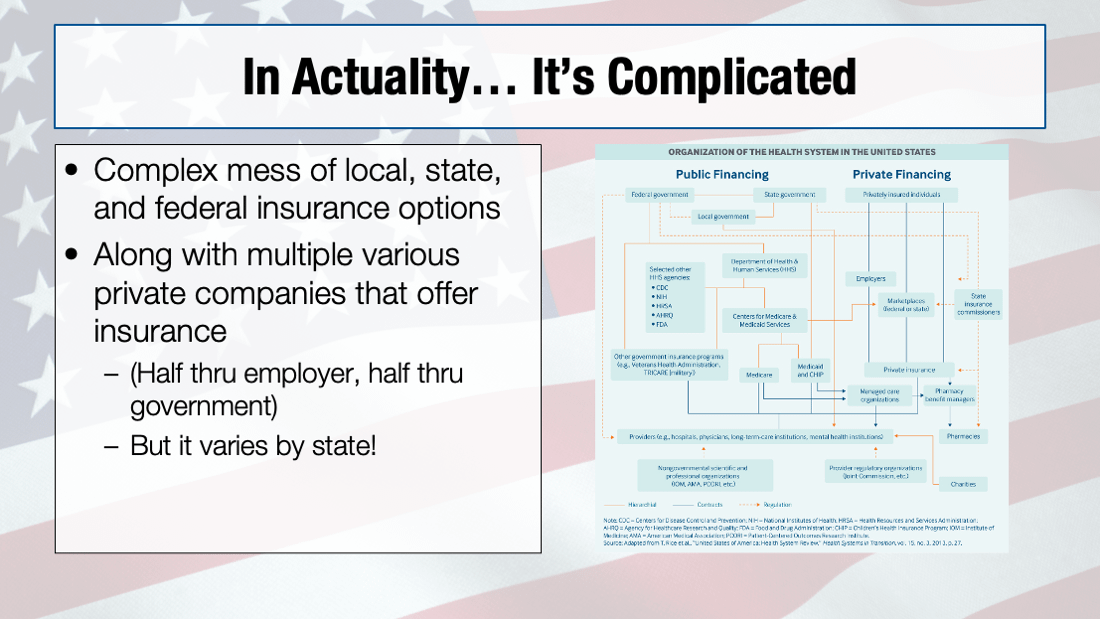
Medicare is a critical piece of insuring (and paying for) the care for patients who also tend to be the sickest (those 65+ and those on dialysis).
And Medicaid is only available if you are EXTREMELY poor: $24,353 for a couple or $36,156 for a family of four.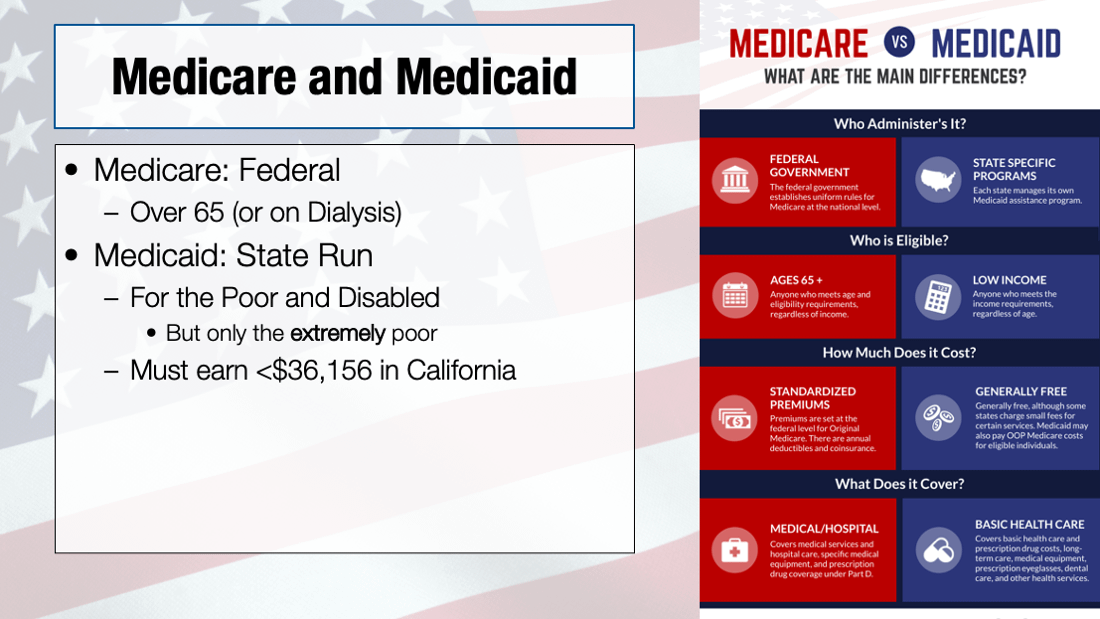
This is maybe the fundamental problem in the US. Like everything in our country, someone wants—or expects—to make a buck on it. And to call it out, that's me too. Doctors tend to be "for-profit." And "non-profits" still make a profit as well.
⬆️revenue OR ⬇️cost = profit/bonuses!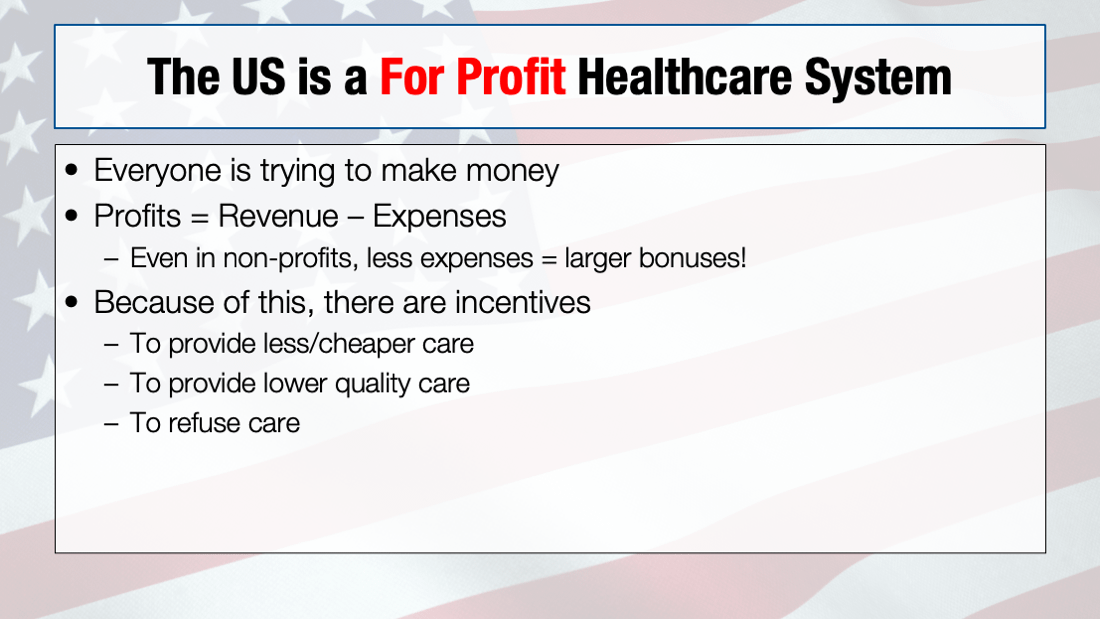
There is incentive everywhere to DO more *and* OFFER less in American healthcare. Want to see literal horror stories of insurers refusing to provide tests or treatments? Cancer patients dying in pain? Just skim this thread on prior authorizations.
twitter.com/grahamwalker/status/1537586882267164672?s=20&t=a1sY-c9H6cKNikFJV5oQAw
(No, seriously. Some of these tweets were the next slide in my talk. I stood up there showing these 🇯🇵&🇦🇺 doctors what American doctors and patients go through on a daily basis in order to get basic, standard medical services. None of this is fancy or extravagant.)
(Slides emphasizing to the audience, "Hey it could be worse, I could live and practice medicine and get care in America")
Honestly, it's a little hard to answer "Why We're Like This" besides "initially employers wanted to entice employees by offering health insurance as a benefit."
And it's stayed that way because we often fight national coverage — including physicians ourselves fighting it.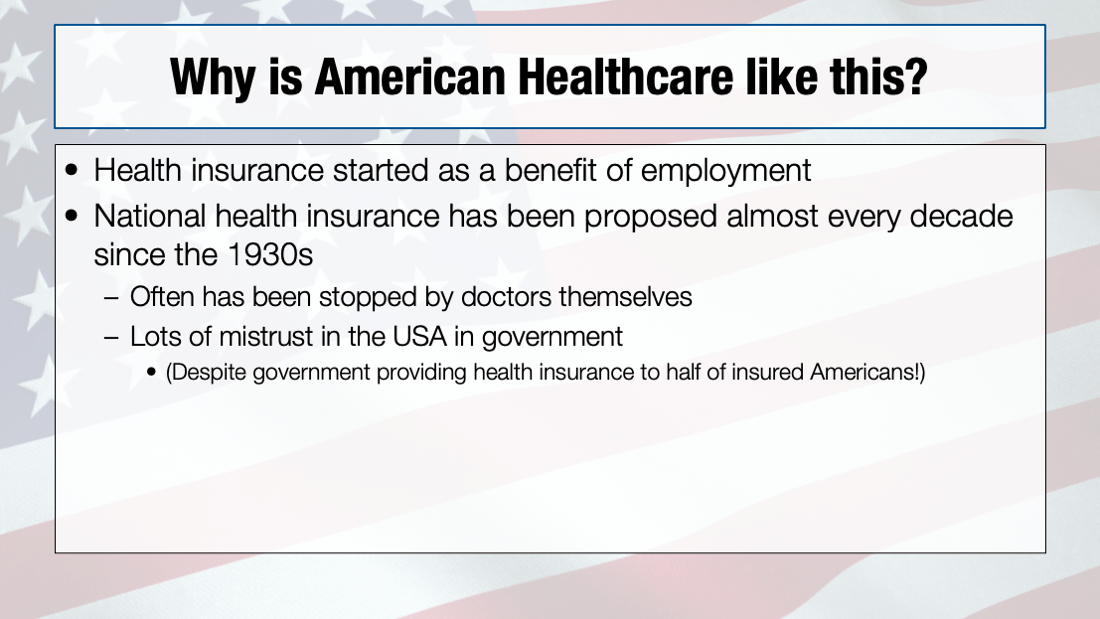
If you're an American and you get health insurance through your employer, you know this "choose your benefits" page. (I'd like to emphasize: you're never allowed to choose your *doctor.* Just your health insurer and how much you agree to pay them if you get sick.)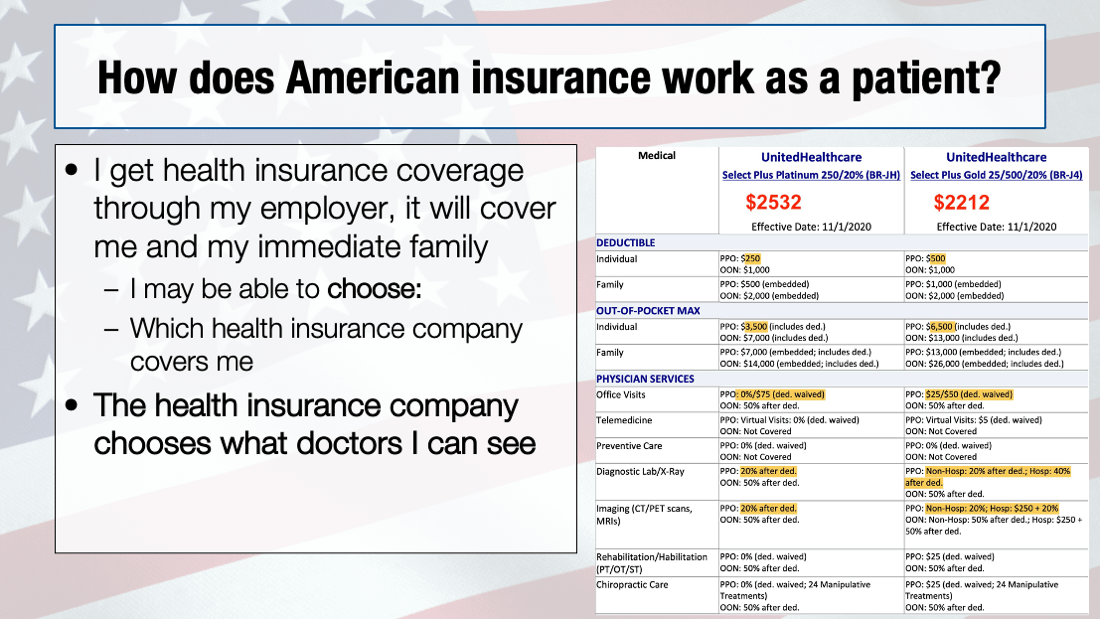
Since no one really decides "Hmm, I think I'll get appendicitis tomorrow," it's nearly impossible for anyone—even a doctor or a health insurance salesman—to know if the silver, gold, or platinum plan is best for them. For many it's a roll of the dice.🎲
I did some brief cost comparisons that I could find; here's Japan's: if you need a stent in your artery for heart attack, it'll cost about $8,000 in Japan.
In the US, it costs $23,000 ± $20,000. 3-5 times as much, for the same procedure. Similar outcomes.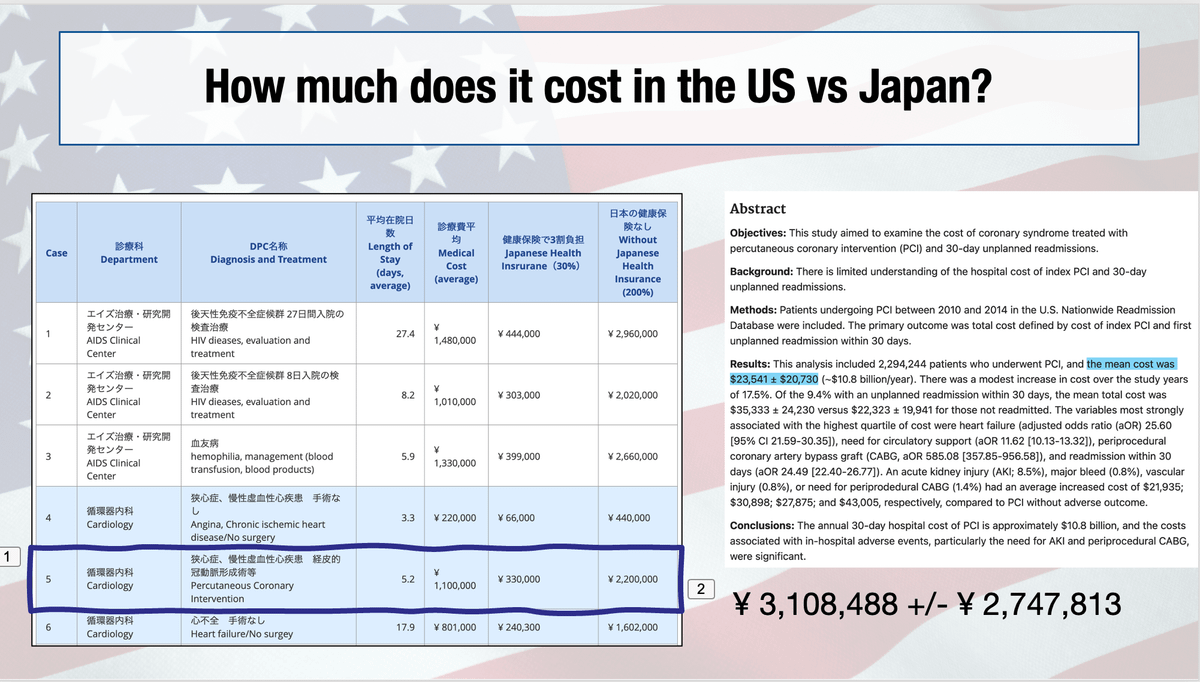
And here's one for Australia; ~$12,000 in Australia for the stent.
(Also featured: the story of this INSURED American man who had an appendicitis bill for $41,000 and after insurance he still owed $28,000.)
Which brings me to my final few points: exorbitant healthcare bills don't just affect the uninsured in our country. Go read the stories of these people. Many were insured. Many knew how to navigate our system.
npr.org/sections/health-shots/2022/06/16/1104969627/medical-debt-upended-their-lives-heres-what-it-took-from-them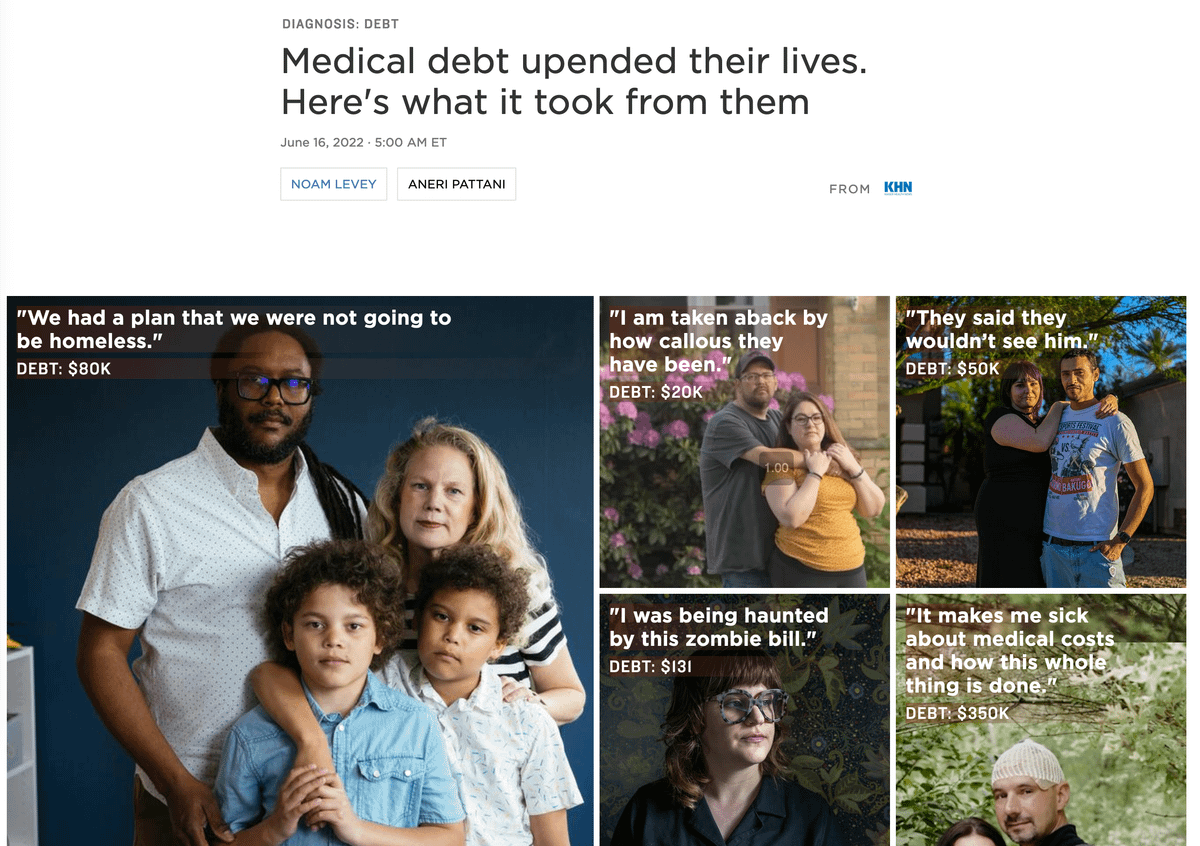
Here's what Americans do if they can't afford their medical debt: They cut spending on food, clothing, or other basics.
They take a second or 3rd job.
They declare bankruptcy.
They lose their home.
They don't fill their prescriptions, to keep them healthy in the first place.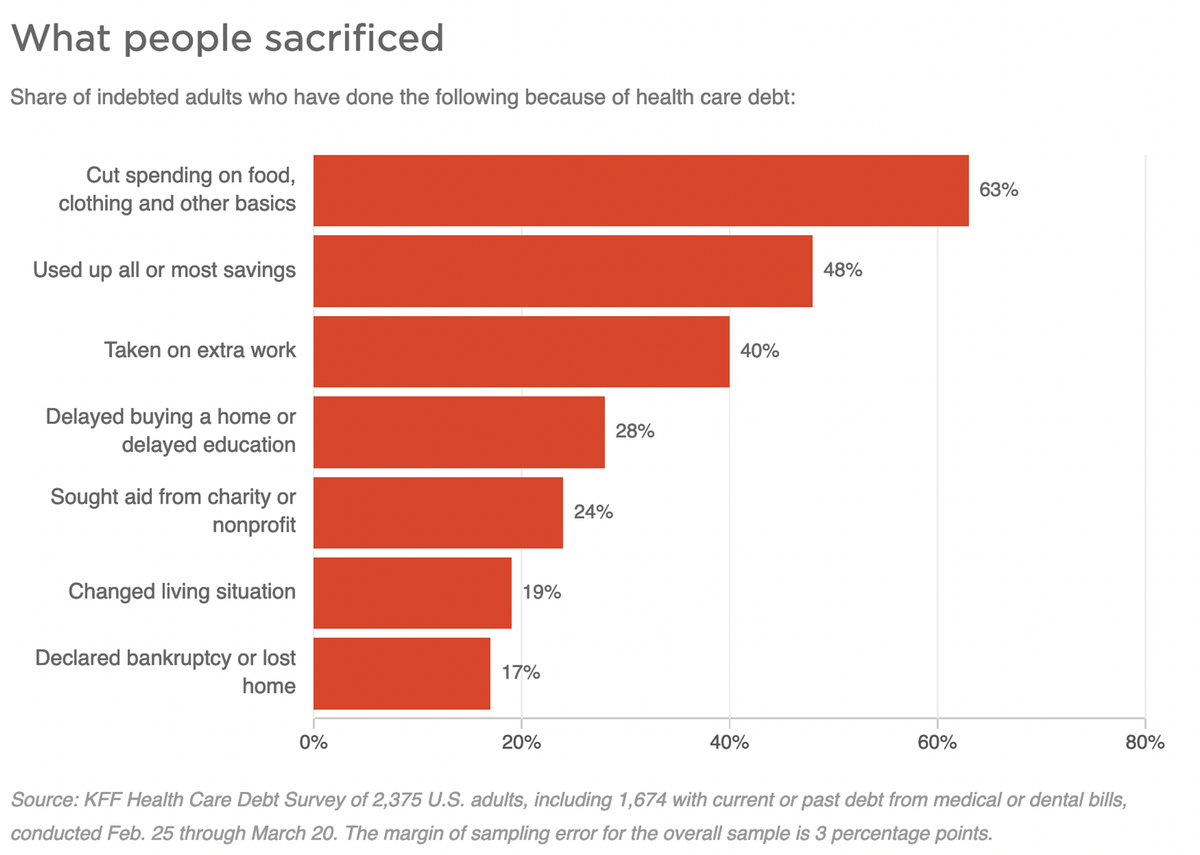
41% of Americans surveyed reported healthcare debt in this survey. In Japan, Australia, or any other modern country that number would be ~0. It would be unheard of. Unspeakable. Unconscionable.
You can get cancer for no reason and go bankrupt in the US.
Life or debt.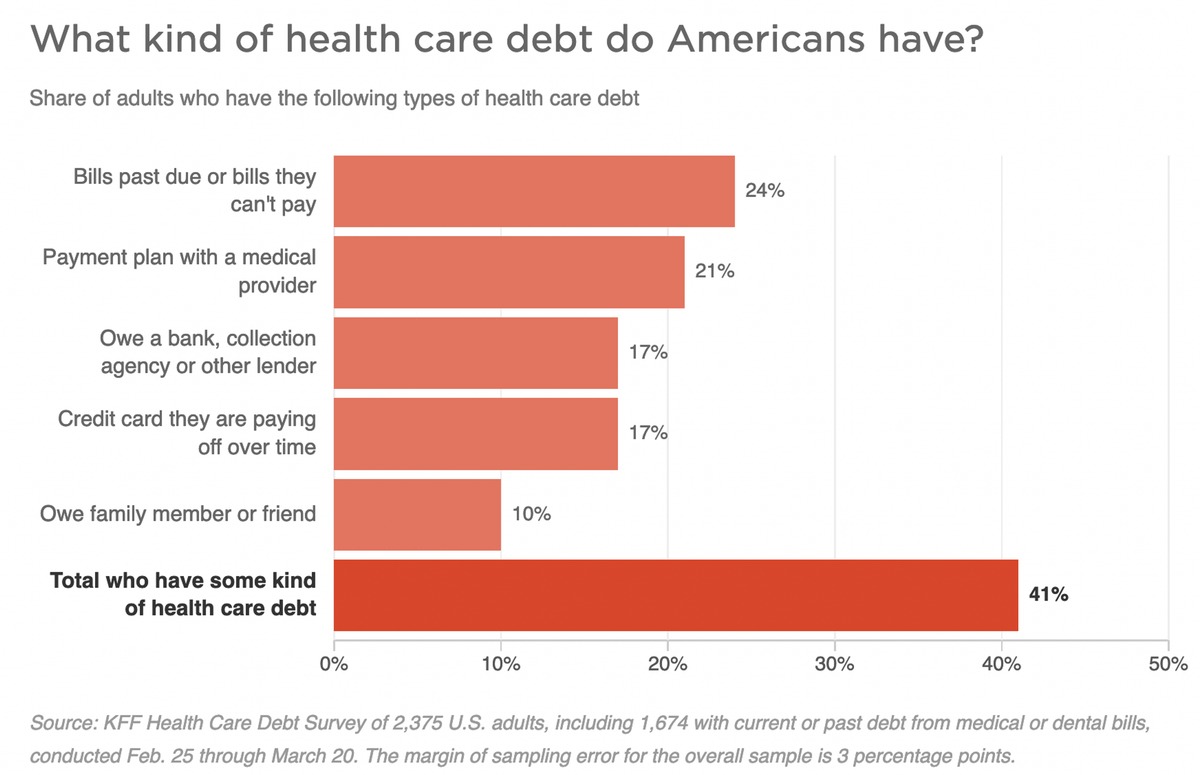
You don't need to be poor to have medical debt.
You don't need to be uninsured to have medical debt.
Most of the time, at least in my experience as an emergency doctor? You just need to be unlucky.
(But being poor or a minority unfairly increases those odds.)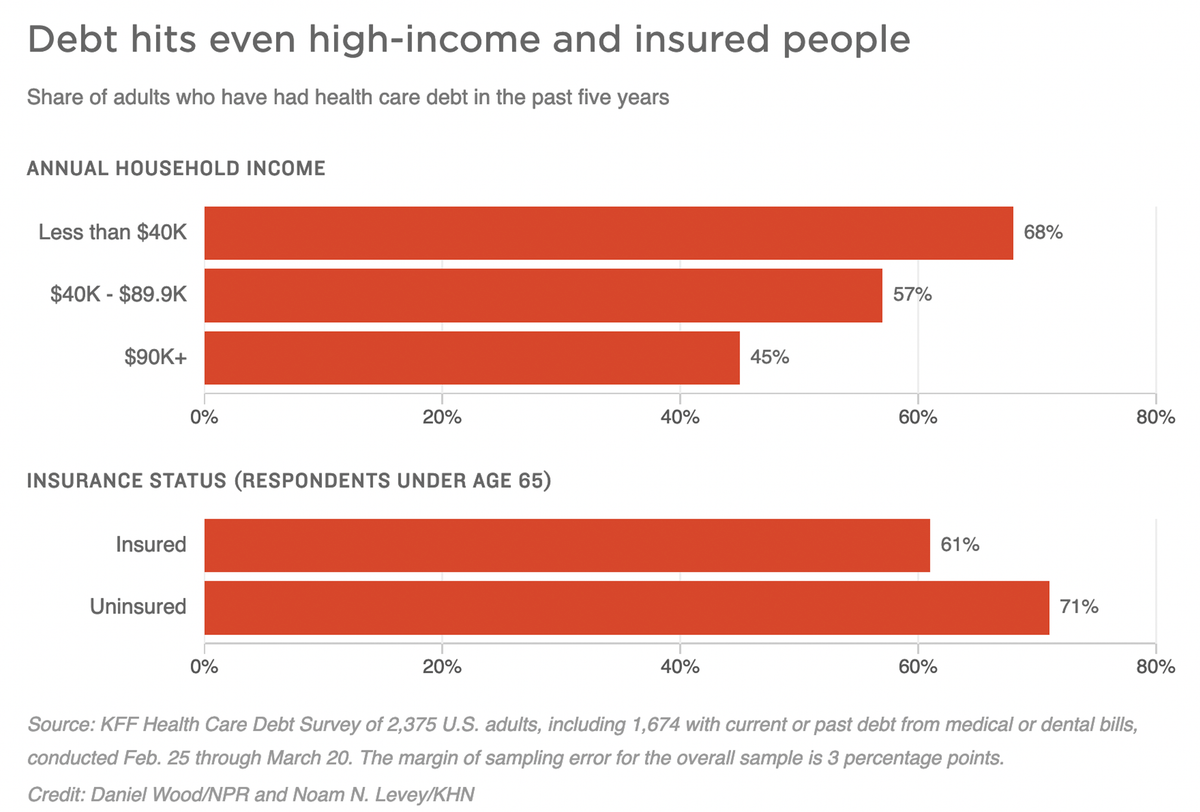
So, if it's this shitty for patients, it must just be a piece-of-cake for doctors, right? I mean, if the system hurts patients, surely doctors come out on top and love it, right?
Um, no.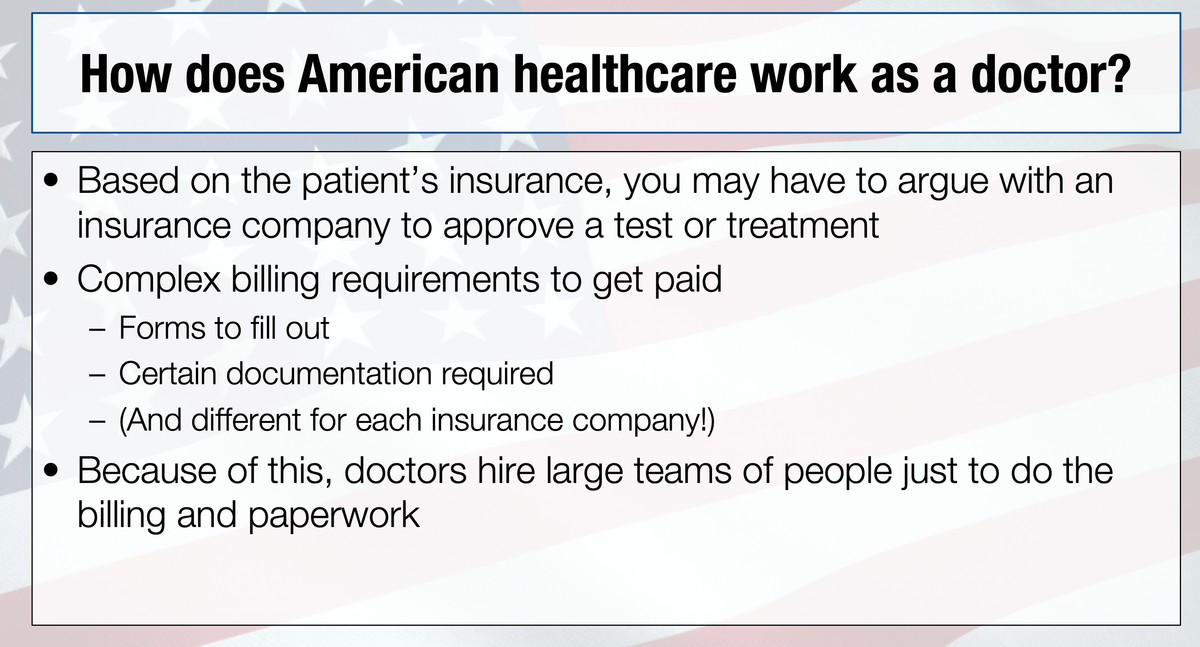
There are regulations, various forms to fill out, and boxes to check. Don't check the right one? Or not in the right order? Or bill code E11+Z79.4 instead of E11+Z79.84? You might not get paid. So doctors have entire TEAMS of people who just do billing for them. Full time.
It costs, on average, $61.54 for an ER to bill an ER patient, and it takes 32 minutes of human processing time. And in fact, 25% of the payment that the ER receives goes directly to paying for the billing. 25% that's not going to the doctor, or the nurse, or the equipment.
It's not going to pay for the oxygen, or the life-saving antibiotics, or the overtime pay to get your appendix out. I mean, imagine if it was 10% instead of 25%. Split it in half, give half to the ER, and half back to the patient!
Well, that was my talk. It was 30 minutes, with great questions, discussion, debate, and honestly a lot of head-scratching. It wasn't easy to present, but arguably I think it was important — especially as countries consider further privatization of their healthcare systems.
I have plenty of opinions on how we need to change, but I don't see any willpower to make it happen. I literally can't think of anyone that is *happy* or pleased with our healthcare system. *Any* other system makes more sense than this one.
So why the hell can't we change it?
I used to think "Wow, someone needs to change our system," but I'm now realizing this is *my* system. I've been a doctor now for 14 years. I'm in the thick of it. This is the legacy I want to leave? This garbled, complex mess?
So consider this me, trying to do a tiny part.
Why is it that for healthcare, "American exceptionalism" means "everyone can do this except us," instead of "We're America, we can make it better?" Are we really so deluded to think we've already got it?
It wouldn't be easy, but nothing worth doing is.
twitter.com/maxonsdad/status/1212583129958899712?lang=en
And if you want to summarize this in video/humor mode, look no further than
twitter.com/DGlaucomflecken/status/1547542559278321664?s=20&t=V7ZqMHcc4_-sRbHrciRnDg
Want more? This is an outstanding thorough look at "all the problems in healthcare" on a macro level by @nikillinit (clinical medicine and care delivery have plenty of other problems too)
outofpocket.health/p/all-of-the-main-problems-with-us-healthcare
A few others with recent good content/tweets about US healthcare: @andy23tran @healthcareandy @TurquoiseHC @boltyboy @wah__yan @jfschneidr @BlakeMcKinneyMD @cristianliu @erinbrodwin @davisliumd @amohseni @JosephNSanberg @KayKosmos @julesyoo @chrissyfarr @SPulim @dirkstanley

Graham Walker, MD
@grahamwalker
Emergency physician; I made @mdcalc; Tweets = my own/not employers'. Not a hero, just a well-trained human. So, so tired of COVID. #GetVaccinated 💉