What is @Buffer_Finance and how is it not just another perp. protocol?
A 🧵 providing all you need to know about @Buffer_Finance $BFR (incl. Buffer V2, POL, new tokenomics and my thoughts).
(AIP-7)
Diving in! (1/24)
Some background on Buffer V1.
V1 was a general options platform on @BNBCHAIN @avalancheavax @auroraisnear, with expiry ranging from 1 - 90 days.
Their support for binary options was through UI (selling ATM options). LPs write call/puts for specific assets.
What's binary options anyways?
Here's a good thread from the team.
In short:
- You trade whether an asset's price will be higher/lower (without specific difference) than during time of purchase/writing.
- You either win according to the payout ratio or lose all your deposit.
twitter.com/Buffer_Finance/status/1554527493192810496
Now, what is Buffer V2.
V2 was a total revamp from V1.
- Relaunched on @arbitrum
- Sole focus on offering binary options (no custom strike prices)
- New tokenomics
- Changed expiry range to 5 mins - 24 hours.
V2 initially followed @GMX_IO 's design.
They had two tokens:
- $BFR ($GMX equivalent, 30% of revenue generated)
- $BLP ($GLP equivalent, 70% of revenue generated)
$BFR staking model -> yield in $USDC + $esBFR + multiplier points.
This changed not long after launch.
The $BLP pool.
$BLP was the counterparty of trades, where users could deposit $USDC to be counterparty (or the "house") of traders.
The pool is expected to hover around 1 $USDC.
Within 12 days of its launch, it experienced major volatility that the team discontinued it.
Enter, Protocol Owned Liquidity (POL).
As a result, the protocol will act as the full counterparty of traders. Offering predictability.
The POL was seeded with 75.5k $USDC, and is currently around 109k $USDC.
Now $BFR stakers earn 40% of fees generated, and Buffer taking 60%.
The staking mechanism forked from @GMX_IO stays.
Note that they are paying 40% of fees generated in $USDC to $BFR stakers. #realyield
Context:
gmxio.gitbook.io/gmx/rewards
Scaling the POL.
The largest drawback to shifting to the POL model is scalability.
Liquidity can't be easily sourced externally now.
Real-time POL value:
debank.com/profile/0x4d338bc1a2380752736718f49bd45d9a040fdff8
👇
Here's some of the ways they will grow the POL:
- Sell discounted $esBFR via OTC
- $BFR collateralized bonds (@arborfinance ?)
- Reinvesting generated fees
- NFT sales proceed
or they might relaunch $BLP, with updated parameters.
Payout ratio.
It can be statistically predicted that the "house/POL" wins on average (in a large sample size).
Payout ratios.
Crypto - 70%
FX/Commodities - 90%
The payout ratio is a "substitute" to fees and to incentivize LPs for highly-skewed periods.
Example 👇
With a payout ratio of 70% (1:0.7).
Traders who win gets 1.7x of their deposit.
Traders who lose gets nothing.
If notional longs ~= shorts, then average fees per trade would be 15%.
Alfa:
(soon) using $BFR, you get a higher payout ratio than opening with $USDC.
Some parameters of the POL.
To manage risks long-tail risks, these have been implemented.
Max trade size -> 0.3% of available POL.
Max utilization -> 10% of available POL.
Pause trading -> in highly volatile times, at team's discretion
Oracle.
They are currently using a custom oracle feed from Binance.
Oracle will be open-sourced on full mainnet.
Tokenomics.
Their V1 token is $iBFR, and can be 1:1 migrated to the new $BFR (closing soon).
Total supply is 100mn.
~28mn circ., giving a circ. m. cap. of ~US$ 13.4mn @ 0.478. (DexsScreener and CoinGecko tracked wrongly)
Token distribution.
Here's my interpretation of the new token distribution, please do check out their docs for the latest version.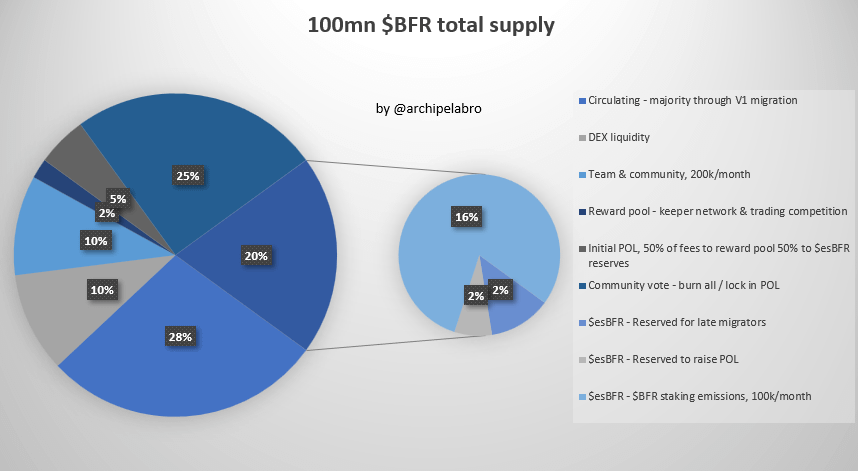
Now that you understood @Buffer_Finance, its design, V1 and V2.
Here's some of my thoughts and updates:
1) Suitable for DeFi
2) Cross-chain support
3) Dynamic team
4) FX, commodities and 80+ new pairs
1) Suitable for DeFi
twitter.com/DefiMoon/status/1584610330407489536
2) Cross-chain support
Currently, only @arbitrum is supported.
But the team has confirmed plans to go cross-chain.
3) Dynamic team
Reading through the thread, you'll notice.
They saw an opportunity (no one doing decentralized binary options), and acted quick. Leaving their V1 progress.
Again, when $BLP failed.
twitter.com/daman_n_diu/status/1586992233596604416
4) FX, commodities and 80+ new pairs
Forex and commodities will be live when full mainnet is live, in addition to 80+ pairs.
Currently only selected crypto assets are supported.
Useful resources:
(the best pre-POL Buffer coverage out there)
twitter.com/LouisCooper_/status/1583473262255751168
buffer-finance.medium.com/buffer-finance-tokenomics-and-other-details-4ceb2debb305
buffer-finance.medium.com/protocol-owned-liqudity-and-the-way-forward-ad321a13b657
twitter.com/Buffer_Finance/status/1554527493192810496
twitter.com/Buffer_Finance/status/1556724379777699841
twitter.com/Buffer_Finance/status/1584253098981470208
medium.com/@buffer-finance/bfr-tokenomics-a52b4ecc4817
(gud reading on GMX)
twitter.com/DeFi_Cheetah/status/1577419254907162624
twitter.com/LouisCooper_/status/1583473262255751168

mimi
@defi_mimi
(images by @midjourney) Just sharing what we're curious about, in simple English -- NFA.