On shaping shots in golf.
I guarantee this thread🧵 will be one of the most informative threads on shaping you will ever read. Bookmark it.📚
Let's go 👇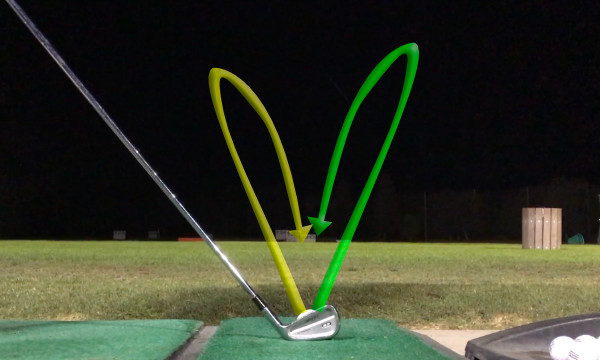
There is no reason why a shaped shot would be significantly more predictable than a square path (with some caveats), for a given distance.
For example, a
▪️square path with 2 degree face variance around it
will produce pretty much the same outcome as a
▪️5 deg in to out path and 4 deg variance around it.
However....
A player who presents a draw path and face closed to it (the same numbers each time) will have less curve with a wedge and more curve with a driver.
So it may be more manageable throughout the bag to maintain a more square path.
Also, into/downwind, a player shaping less will get more consistent outcomes.
This would suggest a more neutral path is easier.
The only real caveat to that would be if someone, on an individual level, produces a tighter dispersion when they try to shape it one way.
This could be for biological reasons (perhaps their body works better that way), or mental (perhaps their movement variability is less when they visualize or are comfortable hitting X shape. The only real way of knowing this would be to test.
It's a myth that a shape will "take out one side of the golf course".
If anything, hitting a bigger shape brings in more complexity (as the above shows).
A player with a neutral path might miss left or right of their target, but a drawer also misses left and right (they're called hooks and pushes).
The most important part is the SIZE (or standard deviation) of the player's dispersion.
We often hear that the best course of action is to "play your natural shape".
Interestingly, I have found throughout the years that many people produce tighter dispersions when fighting their natural shape. I believe @LouStagner also found this to be true.
I also don't like people to shape both ways on the golf course, unless necessary.
There's not much of an advantage to be had unless you have almost equal capability with both shapes.
I'd say less than 0.1% of people would fall into this category.
However, it can be a fun exercise to learn how to do both shapes on the range.
You may need it if you're stuck behind a tree.
And the ability to shape it both ways can help you. E.g. if I hate my hook, I feel a fade swing to calibrate/neutralize it
I've also found that a fader tends to have a slightly narrower side to side dispersion, but at the cost of greater distance dispersion.
A drawer tends to have tighter distance dispersion, but at the cost of marginally bigger side-to-side dispersion.
The effect is small, but there is a good physics-based rationale for why this is the case.
I'll go through that more in later threads - so make sure to follow me @adamyounggolf
So, in summary
▪️it's ok to shape it, but probably don't want to do too much
▪️it's also ok to try and hit it more neutral
▪️there may be subtle advantages to certain shapes, and a small population who could take advantage of this
▪️but there are also advantages to trying to play as neutral as possible
▪️you're better off playing YOUR best shape 99% of the time
▪️although understand that your best shape might not be your natural one
Generally, I prefer going towards more neutral, or smaller shapes.
Congratulations if you got to the end of this threa. Give it a like👍 to show you're one of the real golf geeks.
Want to dive into advanced topics?
Check out my "7 Advanced Ways To Improve Your Golf Game" video presentation. It's free here - adamyounggolf.com/prm-7-advanced-ways/?aff=Twitter

Adam Young Golf
@adamyounggolf
Author of the amazon #golf best-seller - The Practice Manual. Click here to find out more - amzn.to/2Iz4DyT