📖 A Story of Founders & Startups, Fathers & Sons 🧵
This baby is my dad.
His biological father, an Italian WWII vet, abandoned him at birth and so his mother - poor and helpless - put him up for adoption.
Tragically, we learned recently she had died homeless in Atlantic City.
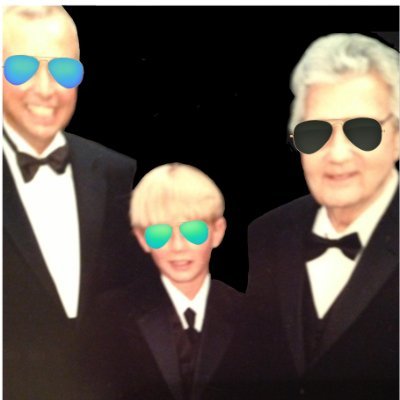
He was adopted by another Italian WWII vet, Domenic Licciardello (right).
Domenic's dad, Joseph (left), immigrated from Sicily in the early 1900's to New Jersey and got his start pushing a fish cart around Trenton, NJ which later led to him starting a produce distribution shop.
That business is run by my dad's two brothers, my Uncles Alex and Joey, to this day - best tomatoes in Joisey!
My dad's first job was there (as was mine), but from an early age he showed signs of being one of the crazy ones and so took a different path than that of his brothers.
Despite getting expelled from two Catholic high schools, he was first in his family to go to college.
Starting at the University of Scranton (he claims he got it confused it with Stanford), he would go on to get his PhD in physics from the University of Virginia.
During his postdoc at Cambridge he studied with a future Nobel Laureate, David Thouless, and from there was recruited by another future Nobel Laureate, Philip Anderson, to Princeton University.
He studied quantum mechanics and had an office across the hall from John Nash.
Although his research was highly cited - "Scaling Theory of Localization", a paper known in physics circles as the "Gang of Four paper", is being considered for a Nobel Prize (it would be Philip Anderson's second!!!) - the "publish or perish" realities of academia frustrated him.
So he and some of his students spent their days coding early PCs and thinking about startup business ideas.
One of his students had an idea for a startup, moved west and extended an invite to join the team.
My dad passed as he had his own ideas and didn't want to move out west.
That startup, Dynamical Systems Research, would shortly thereafter be acquired by Microsoft in 1986.
Its founder, my dad's ex-graduate student, Nathan Myhrvold, would become Microsoft's first Chief Technology Officer.
No matter, my dad soldiered on and founded an "e-banking" company, Princeton Telecom, in 1984 (later renamed to Princeton eCom).
My mom (seen in last photo) quit her elementary school teaching job to support the startup.
Sadly, his startup didn't enjoy the same meteoric rise Microsoft did.
Banks were (and remain) slow to adopt new technology.
As money problems strained the marriage, my parents divorced in 1992.
My mom returned to teaching. My sister and I lived much of our childhood with her.
Our relationship with our father during these years was complicated.
There are many archetypal stories such as my sister and I having to often spend our after school hours at the office late into the night, missed birthdays and ball games, etc.
Court custody battles ensued.
Nevertheless, he persisted.
Towards the end of the 1990's, the fortunes of many struggling internet startups changed dramatically.
As was common at the time, "The Suits" descended upon my dad's company and offered him $7m to step down so they could install a "grownup" as CEO.
Sensing an imminent burst to the dotcom bubble, my dad felt he had to take the deal.
The Suits installed one of their own as CEO, invested $100m+ into technology they didn't understand, and ultimately had an unremarkable exit in 2006 for $180m.
My dad loves to recount the day his bank account went from $7.25 to $7,000,007.25.
"15 years to get rich quick"
Our family's life changed dramatically.
My dad made earnest efforts to be a better father, he remarried, got a mountain timeshare, new baby sis, etc.
Life was good.
So now my dad would just settle into a plush retirement life, right?
Get the f*** outta here...
While vacationing in Mexico, he came across an article in the New York Times about Western Union and how challenging it is for immigrants to send their money home.
He's confused as to why he can get cash with his bank card instantly, 24/7, at any ATM, at a reasonable cost, yet these people wait hours at a money agent window.
The reason, he learns, is he is banked and they are not.
On a beach, he stares at his own bank card and wonders.
The standard ATM protocol assumes a two-factor, reusable authentication:
Something you have, a card, and something you know, a PIN.
This requires a pre-existing relationship to issue a particular card associated with a specific account.
The card has a name engraved on it.
But what if the relationship between the card and code was broken?
Instead, a one-time-use code could authorize the transaction (1-factor auth) and the card could be a generic "access" device.
The card has no associated value, account or name - it isn't "activated" or "loaded".
For security, a longer code than the standard 4-digit PIN is needed, but in fact all standard ATMs will allow up to 12-digits to be entered.
BADA BING!!
Randomized, one-time-use codes can be sold at retail POS and redeemed at any ATM using freely distributed ATM "access" cards.
Because this model uses the standard ATM authorization protocol (ISO 8583), with a single card issuing bank partner it works on every ATM.
There are ~60k ATMs in Mexico where cash is available instantly, 24/7/365 whereas Western Union has only ~30k limited hour locations.
My dad founded American Cash Exchange, Inc. (ACE) and branded the inaugural cash transfer product Poni.
He began to pour his own money into this new venture, developing and patenting the technology and funding a pilot in Tucson, Arizona.
The pilot was successful and so he went fund raising, but being the hard-headed intransigent that he is, rejected various Series A term sheets from Silicon Valley VCs who he felt undervalued his company.
Running out of money he shuts down the pilot and explored other options.
Some time passes and this is when I enter into the Poni picture.
I was born John Domenic Licciardello, named after my two grandfathers, but from infancy was given the nickname "Little Donny" because my family saw me as a "carbon copy" of my father.
Aside from a visible resemblance, I was cut from the same cloth in every way.
A late talking baby, early ADHD diagnosis, ungovernable in school, 10+ run-ins with the cops by 18 - and a natural born tinkerer.
As a toddler, my grandpa would start calling me the "little engineer".
Concerned about my rebellious behavior and disinterest in school, a "professional" recommended I be sent to a reform boarding school.
I couldn't grok their "character development" indoctrination and got myself transferred to a sister school where the program was less stringent.
So, like my father, a failure to conform led me to three high schools.
I guess I'm also one of the crazy ones, a misfit, a troublemaker...
My SAT scores helped me overcome my high school GPA to get me accepted to the mechanical engineering program at the University of Delaware.
I wasn't clued into ACE but by my junior year I could tell things weren't going well.
The timeshare was gone. Money was tight.
My dad explained to me the idea and I thought it was brilliant. I wanted to help.
I moved to Mexico City in 2011, by myself, to be on the front lines.
With little money behind us it was tough going initially, but luckily the street tacos were cheap (and delicious!).
By 2013, we had made real progress getting major retailers in Mexico (7eleven, Extra) to carry the cards and sell the one-time-use transfer codes at their POS.
At the end of 2013, we raised a $10m Series A from a group of angel investors.
The round was led by the former Citigroup CEO, John Reed, who I recently learned also played a small role in the PayPal/X.com origin story.
Mamma mìa it's a small world!
h/t @jimmyasoni
With funding secured we started to turn up the marketing dial including hiring a Mexican celebrity, Pedrito Fernandez, to help promote the product.
By late 2014 / early 2015, we began to see auspicious sales growth and other related KPIs looked promising.
August, 2015 we reach a fully executed $10m Series B term sheet with Cardtronics, the world's largest ATM company, at a $75m pre-money valuation.
Then disaster.
During due diligence Mexico's version of FinCEN (CNBV) without warning revoked our Money Transmitter license forcing us to shut down operations.
Bad timing.
We had had our lawyers argue that Poni was closed-loop prepaid access i.e. same loophole as gift cards.
This exempted us from the typical Know Your Customer (KYC) requirements.
The way Poni works makes it nearly impossible to know who is at the ATM anyway.
ATMs don't have KYC technology.
What are we supposed to do- install 60k ID scanners on ATMs all over Mexico?
Fugetaboutit.
We scrambled to have our licenses renewed but it was a mess. Cardtronics backed out, existing investors did also and the wheels fell off the bus.
The BoD and my dad's relationship soured so they fired him.
Now the second time The Suits pushed him out of a company he founded.
With my dad ousted from the company I couldn't stay.
Unsure of what to do, I returned to school to have some time to think and regroup.
After a brief (and weird) stint at a cryptocurrency startup I soft-landed to a comfortable (and boring) job at a large technology company.
During this time my dad's life fell apart.
He had put all his money into ACE and now in his 70s, couldn't soft-land into a cushy tech job.
His home was foreclosed on, his wife divorced him (now his 3rd failed marriage) and he found himself essentially homeless and bankrupt.
One especially bad day the divorce court charged him 3k in costs, but unable to pay he was held in contempt and thrown in jail. Not allowed to make a call until the next day, he spent the night.
A sad lesson on how being poor is often treated as a crime.
These were hard times as my sister and I would struggle having to support him financially.
But the way our family is, it was also an easy opportunity to pull his chain.
My Uncle Alex and I would play on the guitar for my dad what we loved to tease is his life's theme song.
The Suits from ACE had made various attempts to monetize the IP, but unsuccessful, decided they just wanted to settle outstanding legal claims we had against them (e.g. wrongful termination, etc.).
They offered the IP for a mutual release.
An absolute godsend, we took the deal.
Revealingly, in the settlement docs The Suits describe the "Poni Tech" as "Remittance Tech".
A total failure of imagination.
Remittances are just one potential application of many, and we now know probably not an ideal initial Go-To-Market approach given the regulatory burdens.
We needed to think up a GTM strategy which, at least initially, avoids Money Services Business (MSB) designation by FinCEN - the undertaker of FinTech startups.
I start thinking about all these gig work marketplace platforms (Uber, TaskRabbit, etc.).
There are millions of unbanked gig workers in the US who want to find jobs and be paid safely *in cash*.
Connecting them to gigs in an online marketplace can solve many current challenges for both sides (discovery, reputation, disputes, etc.).
My dad and I co-found Chamba Cash.
Although the death of cash has been a foregone conclusion since the invention of payment cards 70 years ago, nevertheless, cash is still alive and well.
ATMs and Cash in Circulation are at record levels and 1.7 billion adults remain unbanked.
Cash isn't dying, it's *thriving*.
Because the payment in this business model is for gig work services, and it's relatively low value, we can take advantage of various exemptions from MSB designation FinCEN allows.
Also, like other gig work marketplaces, the workers will be classified as independent contractors.
While the relevant regulations are byzantine, the bottom line is we have very credible arguments to defend the business' legality in front of the authorities for having the reckless chutzpah to
[checks notes]
help the unbanked poor, often immigrants, to find jobs and get paid.
Clearly, we are still in the early innings of Chamba Cash.
So why are we telling this story now?
Mostly because it's a good story that deserved to be told.
But also, dear reader, because there are many chapters left to be written and we will need YOUR help!
Capeesh?!
So, if you want to work with some crazy, rebellious, misfit, troublemaker, Joisey boy founders, please reach out.
We are hiring as well as seeking partners and investors.
To work with us, please email me
john at Chamba Cash dot com
We think we can change the world.
Join us.
You can read the unrolled version of this thread here: typefully.com/_jersey_john/WL4nxFM