You might have missed it over the summer holidays but a new paper by Pape and Rossi analysed the impact of the DMA on EU users of Google Maps, and the results show rather significant unintended consequences in the short term ... papers.ssrn.com/sol3/papers.cfm?abstract_id=4922400
The headline is a 25% increase in searches for the term "maps" and an 18% increase in searches for "Google maps", but wait, wasn't the DMA supposed to create more opportunities for rivals? Why are we getting more searches for on Google, for Google products? Let's dig in 👇
The paper hits off on the main point of inquiry (something that is at the core of many of the antitrust cases against Google): Is Google's success because people prefer Google, or is it because of the way Google designs its products to work together ("self-preferencing")
There's a bit of a causality question underlying this, and the implementation of the DMA offers a natural experiment: what happens when you remove the "self-preferencing"?
In the case at hand, the "self-preferencing" consisted of having a clickable map when you search for a location, and having a "Maps" tab in search results. Because of the DMA, these have been removed. x.com/KayJebelli/status/1770790269903888484
Users of course haven't been happy about this change, many took to the internet in the early days to complain about it. x.com/adamkovac/status/1772327023517536744
It's particularly funny because this is one of the few things that Commissioner Breton explicitly promised would not change as a result of the DMA. The concern was dubbed a "myth" linkedin.com/pulse/dsadma-myths-what-eu-digital-regulation-really-thierry-breton/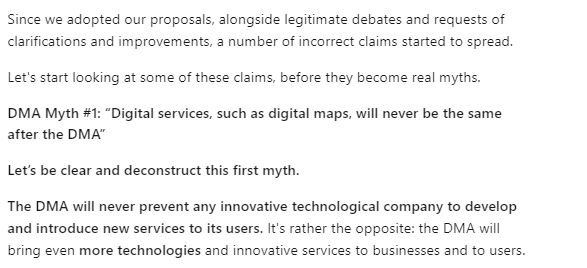
But here we are, and now we're able to look at the second and third order effects of this change. Not only are users complaining, but we can also see what they do next.
Now that users aren't "locked in" by Google's "self-preferencing", are they benefiting from the freedom of using third-party services?
Proponents of the DMA always asserted that this would be the case, and that users would further benefit in the long-run from more choice.
The result is quite mixed! First, the lack of integration has caused 25% more "maps" search queries, this could be coming from people who want the interactive map in response to a search, realise that it's not working in Google Search, and decide to use search to navigate to maps
"This increase in search activity can be seen as a short-term negative effect for users due to higher search costs."
It's not just an annoyance either, the paper does a back-of-the-envelop assessment of the cost based on time wasted and average market wages. €3.3 million per year. It's not nothing.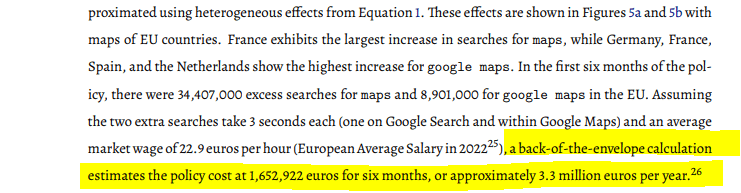
That's a lot of people's time wasted, inconvenience, but has it helped competitors?
Well, not really!
Average weekly search volume overall has increased, but the search share of the different map providers remains largely the same.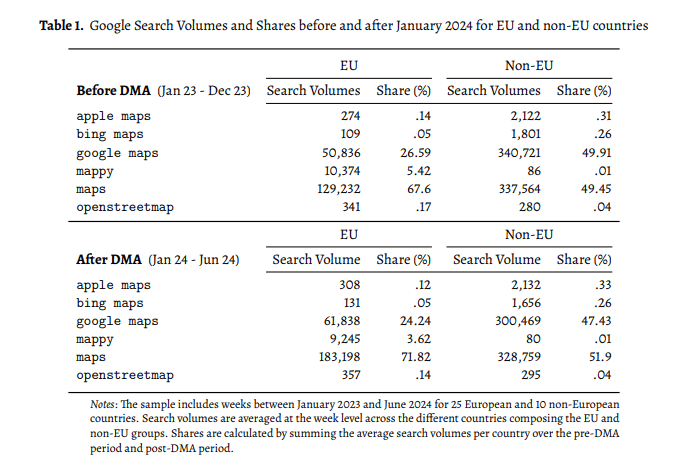
Significantly more people are now searching for "maps" and "google maps" than they were before (meanwhile outside the EU, in the "control" searches for maps actually went down, so presumably they should have gone down in the EU as well, but instead they've spiked)
There's a tiny increase in the number of searches for apple, bing, and openstreetmap (a reduction for French competitor mappy), but it's nothing compared to how many more searches there are for "maps" or for those who are specifically searching for "google maps"
"The magnitude of these estimates is economically significant, as it documents that a large volume of users in the EU have searched for general mapping services, and more specifically for Google Maps, because they cannot access them directly by clicking within Google Search."
So the DMA's efforts to increase user friction in order to help competitors aren't really making a difference. In this example at least, it seems the vast majority of users actually just want to have their google maps integration back, thank you very much.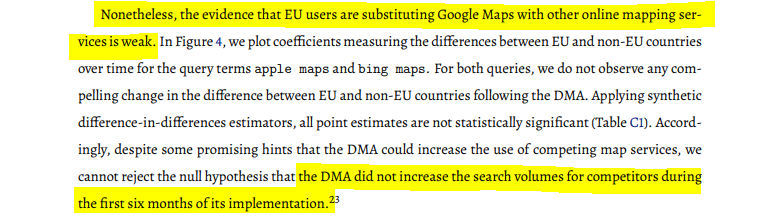
oh and there's a catch with that increased search volume as well, it's not just a waste of user time and unnecessary friction ...
And there's another unintended side-effect that's far more pernicious, the loss of traffic to local businesses that previously got free clicks via Google Maps. It's all going to become a lot more complicated and expensive for them.
So what does this say about the DMA, objectively?
Harming consumers, harming small businesses, and not really helping competitors.
Oh, and it has some unintended side-effects as well.
This of course begs the question, will the EC accept that this is what the data is showing, that people actually just want to use an integrated Google maps, or will it decide to intervene harder, causing even more harm and unintended side-effects? That's the eternal DMA question
x.com/KayJebelli/status/1783631151803871423
Oh, and PS. there are no financial interest conflict disclosures, but based on the tone of the paper, and the references cited, the authors are definitely pro-DMA and pro-intervention.
But you can't argue with the data!

Kay Jebelli 🇺🇦
@KayJebelli
Computer engineer/competition lawyer; TCK, European by choice; personal views expressed. Pro-abundance policy, with clients in the technology industry.