Big antitrust news from Europe, it's not the DMA fines, but it's close, and probably not something the EU wants too much attention on right now
Google has made significant behavioural commitments in Germany over its maps service to boost German automakers x.com/Kartellamt/status/1909894162733769162
This is the kind of thing typically announced at the Spring ABA Antitrust Meeting last week, massive audience along with massive fines, social media posts in English, and press interviews about how they're "reigning in big tech", but in the current climate, that's perceived risky
That doesn't make it any less controversial, if not unexpected. The EU Courts last month gave the green light to all kinds of access claims against US platform providers, even in areas where they are not dominant curia.europa.eu/jcms/upload/docs/application/pdf/2025-02/cp250019en.pdf
The Court basically said that Google has a duty to to develop new software for rivals that want to interoperate with it, or take advantage of its reach and user base. This was in the context of a car-charging app wanting access to Android Auto, but extends much further.
(If you're interested, a Google lawyer posted more of the controversial details on LinkedIn) linkedin.com/posts/terolouko_a-refusal-by-an-undertaking-in-a-dominant-activity-7313914197652742146-IkTw/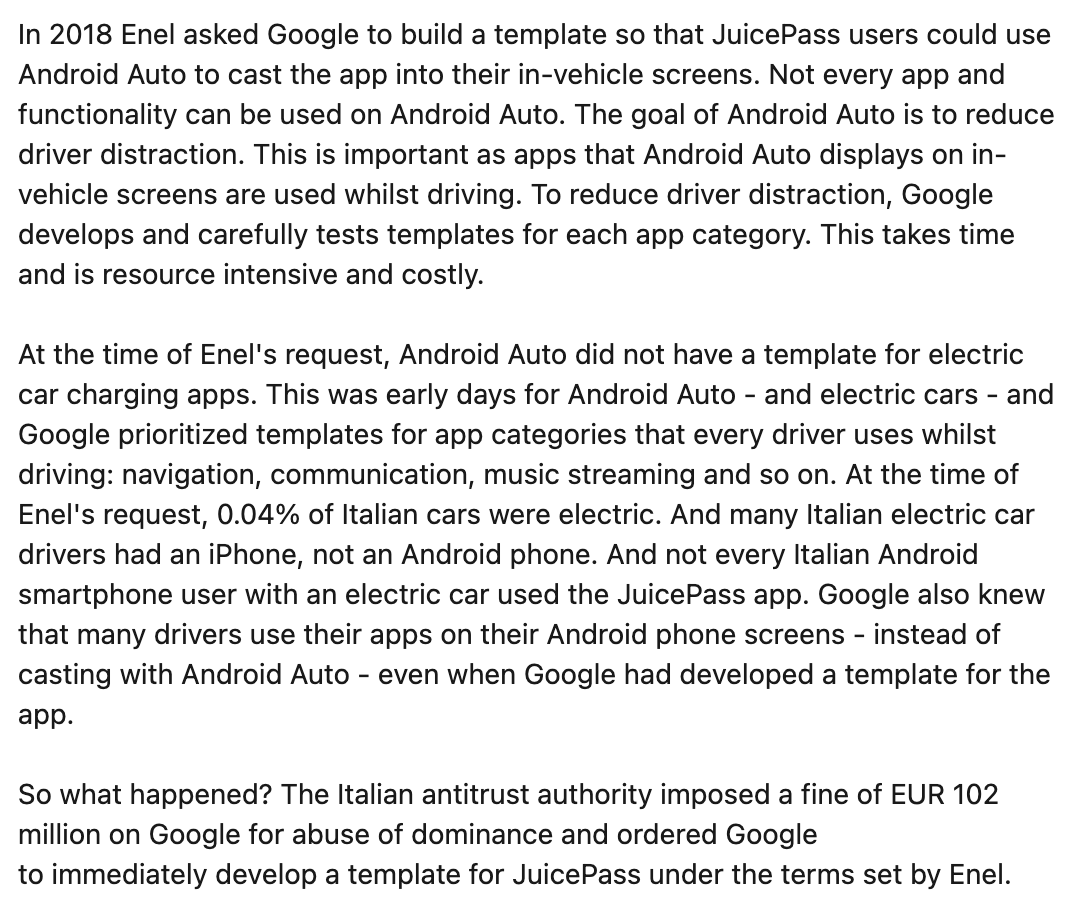
Interestingly, Enel didn't make this request to the big auto makers, it didn't go and strike deals to get its App into the dash-display system of these OEMs, and reach customers that way. It circumvented all that work by going to the authorities and forcing Google to do the work.
Also, Enel wasn't foreclosed from mobile devices either, not even Android devices, it had a growing and successful Android app. But it wanted Google to make a specific functionality in Android Auto for its benefit
And the Italian competition authority, and later the CJEU said OK
(btw, if you want to read up a bit more on the judgment, there's a great blog series by Pablo Ibáñez Colomo, LSE Professor of Competition, amongst other titles) chillingcompetition.com/2025/03/28/case-c-233-23-android-auto-iii-implications-of-the-judgment/
As the Google lawyer pointed out after the judgment, it wasn't enough that Enel was already getting free app distribution. Enel was able to force Google to divert investments towards building products to help Enel reach less than 0.1% of Italian drivers linkedin.com/posts/terolouko_a-refusal-by-an-undertaking-in-a-dominant-activity-7313914197652742146-IkTw/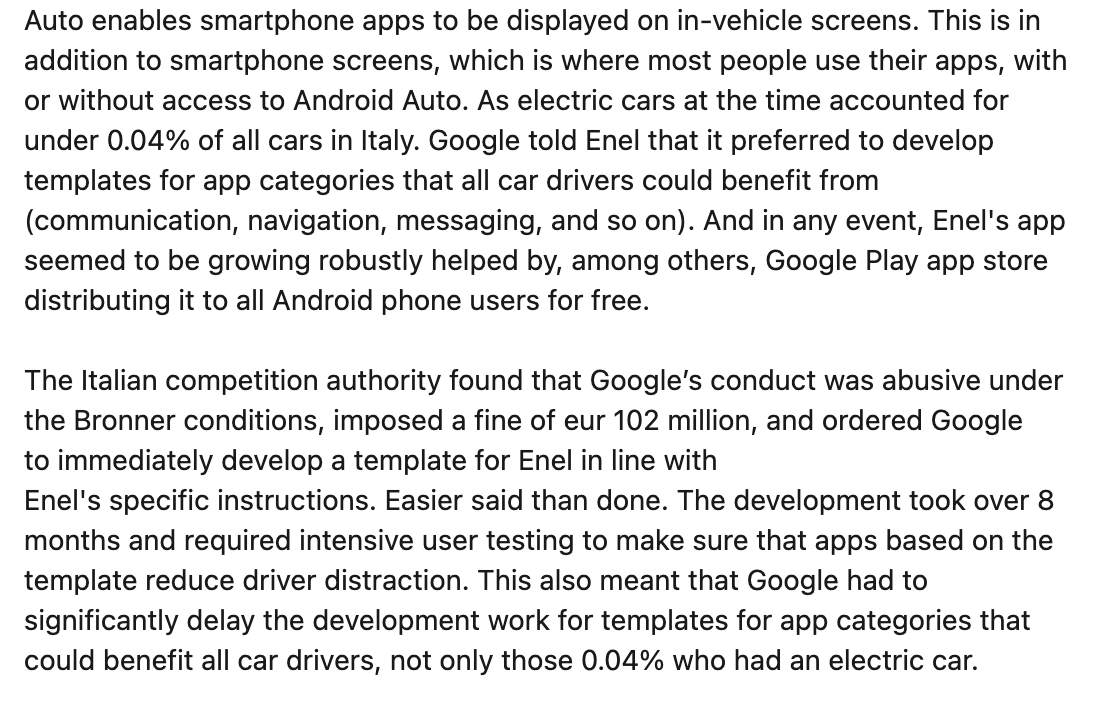
It's sort of like if Enel was able to force Spotify to insert notifications for Enel whenever a driver approached a charging station.
This isn't about making competition work better, it's about competitors getting the state to instrumentalise US tech companies to boost their profit margins.
And the Court (mostly) went along with it. There are some caveats in the Judgment though, so it's untested ... until now
On the back of this judgment, the BKA (German competition authority) has gotten Google to commit to a number of additional changes to Android Auto and its Maps service.
There's actually two separate decisions that have been published, one for Google Automotive Services bundeskartellamt.de/SharedDocs/Entscheidung/EN/Entscheidungen/Missbrauchsaufsicht/2025/B7-25-22_GAS.pdf
And one for Google Maps bundeskartellamt.de/SharedDocs/Entscheidung/EN/Entscheidungen/Missbrauchsaufsicht/2025/B7-25-22_GMP.pdf
First thing of note, both of these cases are based off complaints by TomTom.
Who's that? They're a European mapping service, and for those who were born after 1995, they used to be the dominant in-vehicle navigation provider, until they got disrupted by Google and Apple
They had a wild business model, you would buy the device (sometimes up to €500), but if you wanted to go outside your region, you'd have to pay another €100 for additional maps, another €50/year for map updates, and and then another €100/year for live traffic updates.
Totally disrupted by the mobile web, which does all that for free on the phone you've already bought.
But now TomTom brought this case in Germany to get Google to help them become competitive again.
As a result of the remedies, Google basically has to operate as an infrastructure provider to car infotainment systems, and users of maps services. It's forcing Google to focus on middleware, and open up user surfaces for rivals. bundeskartellamt.de/SharedDocs/Meldung/EN/Pressemitteilungen/2025/04_09_2025_GAS_GMP.html
There are other remedies as well, related to a finding that Google is dominant in mobile, and that this gives it leverage in vehicles (even though this "dominance" is because European vehicle OEMs actually want Google services on the dash, in contrast to e.g. Tesla).
These other remedies (like the unbundling of services) aren't as problematic, though they do put Google at a competitive disadvantage (because rivals can still do the things Google is prevented from doing).
But the real problem is that Google's competitive advantages are being picked apart and appropriated by rivals through competition enforcement.
For example, rival map services want to piggy-back off Google's database of identified and inventoried places
Google of course doesn't want this. It has built and curated the database for one, and second, by combining with Google data, rival map services could end up confusing users, and ultimately making Google look bad (the point of the now eliminated 3.2.3(e))
The BKA doesn't care.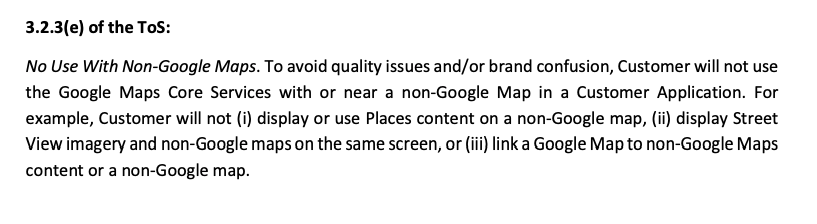
In the BKA's view, rivals should be able to use Google's databases and datastreams, to compete directly with Google.
And that it's OK to infringe Google's property rights to do so.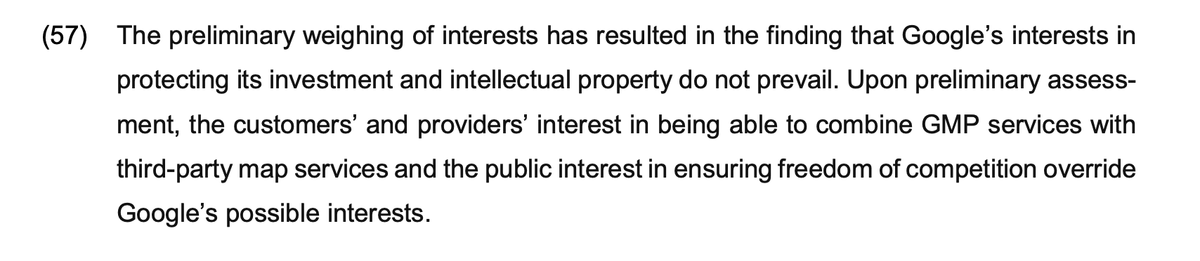
This is what Donald Trump called "the Unfair Exploitation of American Innovation" whitehouse.gov/fact-sheets/2025/02/fact-sheet-president-donald-j-trump-issues-directive-to-prevent-the-unfair-exploitation-of-american-innovation/
It's the same kind of stuff that US FTC Chair Andrew Ferguson has called a "a tax on American companies" , but is increasingly being imposed under EU, and German, ex-ante competition laws pro.politico.eu/news/tariffs-competition-mergers
It's the logic of turning US tech companies, "gatekeepers", into infrastructure providers. I think it's bad in terms of international politics (hence the blow-back), but it's also bad for domestic policy.
I mean, do we really want Google to be more like a telecom company?
Google has flourished by developing innovative tools and services for end-users, and it has reinvested its profits to create more of these (it's one of the biggest R&D spenders in the world).
Telecom companies on the other hand, are notoriously bad to users, and invest minimally
European policymakers believe that this user-facing edge-innovation will be replaced by European rivals, and that these regulatory interventions create that space at the edge for new competition to emerge.
European rivals can certainly be as innovative at the edges as Google can, however ... I would still like to see Google offering a competitive alternative, and I will miss the benefits of deep integration with core innovations, which will be lost.
I'm also worried that this might mean Google has to raise its licensing fees, knowing that customers can use this license to compete with it directly, it's going to
Now, Google has made these commitments, to become an infrastructure service on maps, and they have to do everything they can to make it a success.
Will we see a lot more innovation in this space? Or will it be free-riding and a lot of me-too services? That remains to be seen.
Let's hope for the best, but it also begs the question ... at what cost?

Kay Jebelli 🇺🇦
@KayJebelli
Computer engineer/competition lawyer; TCK, European by choice; personal views expressed. Pro-abundance policy, with clients in the technology industry.