
I went viral on Twitter for a thread with no original content. All I did was highlight other people's work.
So I'll try that now for @abbiearyan.
Landmine clearance is big business, in Afghanistan and elsewhere. But it's basically a huge grift:
linkedin.com/pulse/hollow-work-halo-trust-abbie-aryan-ccmse/
Thread.
I hadn't thought much about demining until Matt Yglesias mentioned it recently, arguing that it wasn't a good use of resources.
I can't find his comment now, so I don't know if he made it after seeing Abbie Aryan's LinkedIn essay.
But the problem is much worse than he implied.
Yglesias is an advocate for "Effective Altruism": the idea that charities should spend money where it's most beneficial.
(You wouldn't expect that to be controversial, but it's become controversial for reasons I won't get into.)
On that basis, mine clearance is hard to defend.
Landmines kill about 5000 people each year, mostly in developing countries.
That's a small fraction of the number killed by preventable diseases like malaria.
So when I saw Yglesias's offhand criticism, it made sense. Even a well-run demining NGO can't be doing that much good.
But Aryan shows that the major NGOs in this sector aren't exactly well-run. Some of them seem to be total scams.
Much of his essay—although not the most bizarre, comical and outrageous sections—examines the work of the HALO Trust, the world's oldest and largest demining charity.
The HALO Trust was founded in 1988 by Colin Mitchell and Guy Willoughby, two ex-British Army officers.
It gained prominence in 1997 when Princess Diana visited one of its projects in Angola.
(The International Campaign to Ban Landmines won the Nobel Peace Price that same year.)
Looking back, this may have been when the broader racket took off.
You might think that if banning the production and 𝘧𝘶𝘵𝘶𝘳𝘦 use of landmines is a worthy cause, locating and removing 𝘦𝘹𝘪𝘴𝘵𝘪𝘯𝘨 mines must also be worthwhile.
But it isn't, at least not necessarily.
It depends on how much you can accomplish, and on how much it costs to get it done.
In the 2022-2023 fiscal year the HALO Trust says it demined just over 8000 hectares of land, equal to 80 million square meters.
But it reports spending over 120 million pounds in the process.
(annual financials at halotrust.org/media/w2qdsoec/the-halo-trust-annual-report-31-march-2023.pdf)
That's £1.50 per square meter.
The numbers look just as absurd if you consider that the Trust employs almost 10,000 people, each of whom clears less than a hectare per year.
And they're addressing a problem they can never solve.
As Aryan points out, it would take nearly 2000 years for the HALO Trust to demine the world.
He puts the cost at £176 billion, which can't conceivably be justified in the face of competing issues like global public health and climate change.
Yet the Trust keeps getting funded.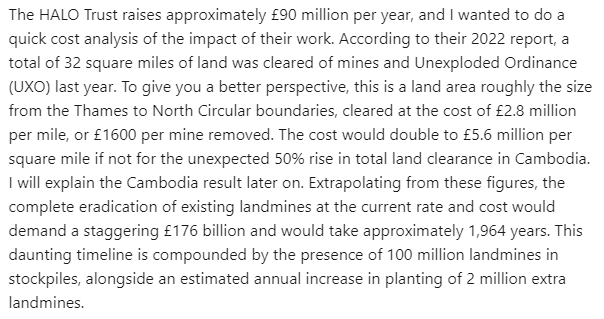
The sums involved make Shabana Basij-Rasikh look like a shoplifter.
Aryan says the UK government has donated £500 million to the Trust since its foundation.
And I see from ProPublica that HALO's tax-exempt US arm raised over $57 million in 2023 alone:
projects.propublica.org/nonprofits/organizations/522158152
A good deal of the Trust's success seems to have come from its excellent relationships in the UK, where it's hired a lot of former army officers.
Colin Mitchell died in 1996, and for the next 18 years the organization was effectively controlled by his co-founder Guy Willoughby.
Willoughby was forced out by the board of trustees in 2014 after complaints about spectacular self-dealing:
bbc.com/news/uk-28176916
(The Trust was paying his children's private school tuition and employing his wife as its official photographer. Aryan is very good on all this.)
He was replaced by James Cowan, another ex-soldier who's served as CEO since then:
en.wikipedia.org/wiki/James_Cowan_(British_Army_officer)
Aryan doesn't mention Cowan in his article. But he does write about a strange incident that took place in British politics last year.
So I shall boldly connect the dots.
In July 2023 Tobias Ellwood, then a Conservative MP, came back from a trip to Afghanistan and released a video full of praise for the new regime.
He told the British public that engagement with the Taliban was essential.
Piers Morgan was unimpressed:
youtube.com/watch?v=1aKlW3YbiJQ
And even those of us who agreed with Ellwood about engagement saw he wasn't well informed.
(In his video he celebrated the installation of solar water pumps by farmers in southern Afghanistan. He seems not to have known that those were put in during the Republic—to grow opium.)
It didn't go well for Ellwood, who had to delete the video and then resigned from the Defence Select Committee just before a scheduled vote to remove him.
Ellwood himself is a former officer, although he never served in Afghanistan. What possessed him to make such naive remarks?
What's been overlooked in the debate over Ellwood's video is that his trip was sponsored by the HALO Trust.
The organization must have given him some kind of briefing, especially since James Cowan runs it.
Cowan commanded British forces in Helmand during the 2009-2010 campaign.
So unlike Ellwood, he's had plenty of personal experience in country.
I wouldn't dream of suggesting that Cowan gave Ellwood a set of talking points in support of the IEA.
But you can't help noticing that Cowan is saying much the same things now that Ellwood said last summer.
Ten days ago, on the anniversary of the takeover, the HALO Trust quoted him in a press release ("Engage With Kabul Or Risk Worsening Crisis") calling for "more diplomatic engagement from western countries":
halotrust.org/latest/halo-updates/news/engage-with-kabul-or-risk-worsening-crisis/
Not surprisingly, he also called for more aid.
I support engagement and aid!
But money spent on the HALO Trust benefits the Trust more than it benefits Afghans. It's a poor use of development funds.
And it seems the Trust isn't even the worst actor in the demining business. This is where Aryan's article gets really wild.
There's the Mine Advisory Group (MAG), also founded by ex-British soldiers.
They don't work in Afghanistan, and seem to specialize in African countries with very few landmines.
Like the HALO Trust, they report costs of over £1 per square meter.
And on a per-mine basis... wow.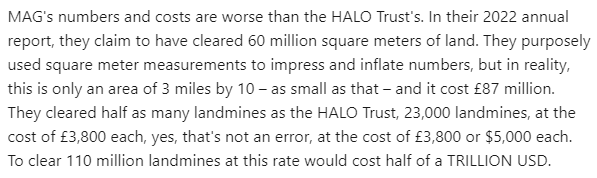
Here in Afghanistan there was the Mine Detection Dog Center (MDC), founded by "Professor" Mohammad Shohab Hakimi.
Aryan says Hakimi took in over $70 million per year from the US Embassy and other donors, as he searched for landmines with his specially trained Afghan hounds.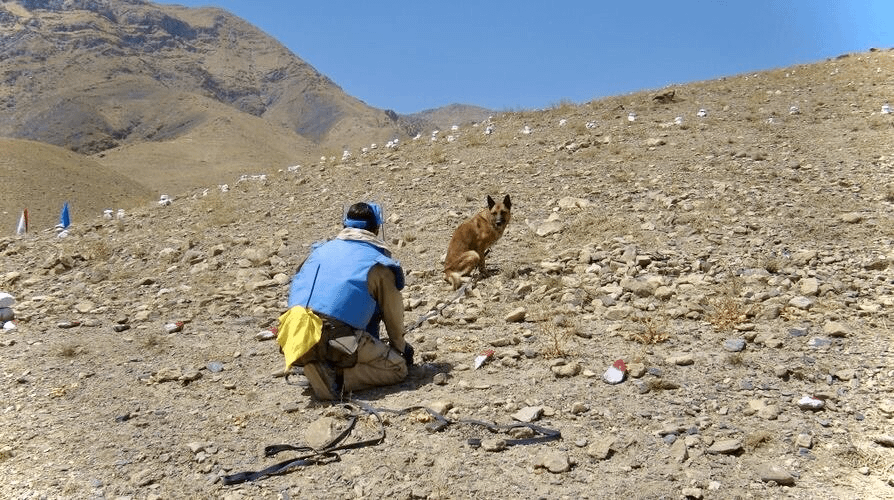
There's an interesting comment on Aryan's article, reporting that Hakimi's mine-sniffing superdogs cost $12,000 each.
It's unclear what distinguished them from other dogs.
But Hakimi claims, mysteriously, that with their help MDC removed 80 percent of the mines in Afghanistan.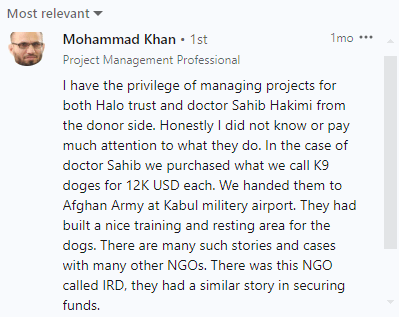
A Belgium-based group, APOPO, says it's developed an even better method.
They train giant African rats to sniff for mines. Since 1997 they've received over $200 million.
(The rats also diagnose people with tuberculosis. I'm sorry, there's more material here than I can use.)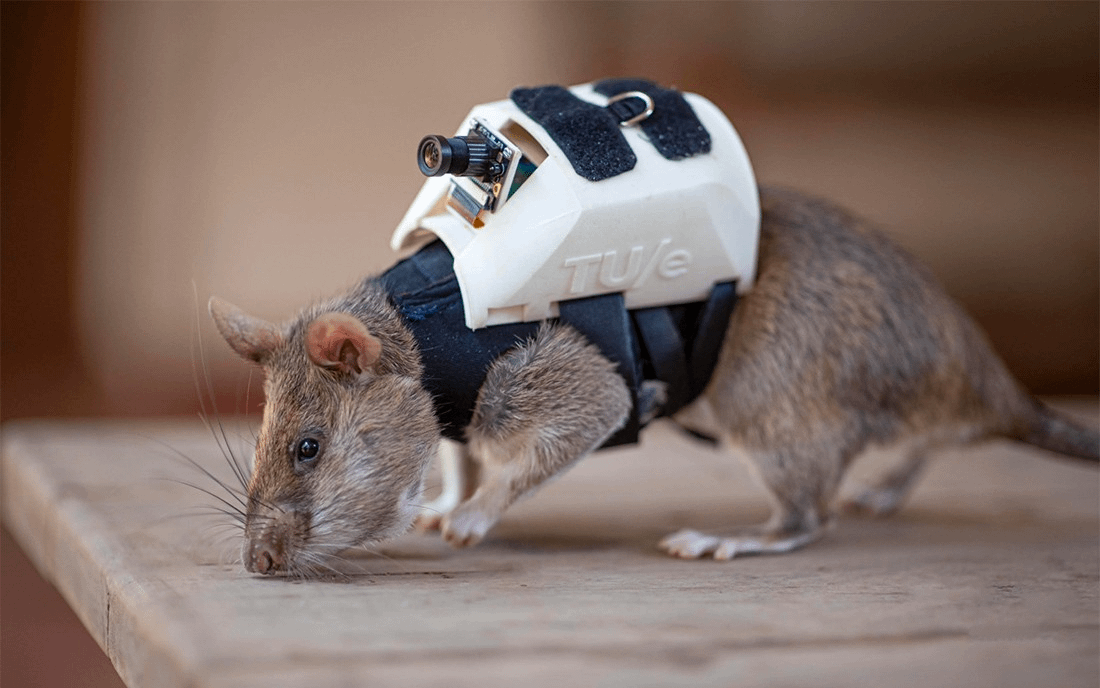
Aryan ends with an inspirational story.
After the Russian invasion of Ukraine, a Ukrainian farmer named Oleksandr Kryvtsov built a remote-controlled, armor-plated tractor to roll over minefields and detonate the mines.
Reuters wrote him up last year:
reuters.com/world/europe/ukrainian-farmer-comes-up-with-novel-way-demine-his-fields-2023-05-02/
But what Aryan has to say is worth reprinting at length.
A comparison between Kryvtsov's tractor and the HALO Trust does not look good at all for the Trust, or for its even more ridiculous competitors.
Gl0ry to Ukr@ine, indeed.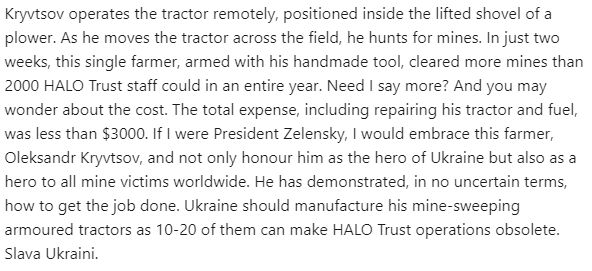
Everyone who's worked in the aid business knows that a lot of money isn't well spent.
But I hadn't realized there was an entire category of "assistance" that's uncomfortably close to pure fraud.
I wonder: how many of these NGOs would even exist if Diana hadn't crashed her car?
I'll shut up now and ask everyone reading this to click over to Abbie Aryan's eye-popping essay, "The Hollow Work of the HALO Trust":
linkedin.com/pulse/hollow-work-halo-trust-abbie-aryan-ccmse/
This piece shouldn't be allowed to languish on LinkedIn.
Some version of it belongs in a newspaper, or on television.
I still have no idea why I was touched by the magic wand last weekend.
But now that my account is getting attention, the least I can do is direct some of it towards an impressive piece of muckraking.
[end]