What can robotics learn from watch design?
- Hundreds of parts packed into a coin-sized case,
- keeping time within ±20 seconds daily
- enduring decades of use
Mechanical design at its most optimal.
Let's explore the mechanisms that make watches tick ⬇️
Start with the rotor - a semicircular weight that spins freely inside the watch case.
Every time you move your wrist, this weighted rotor swings like a pendulum, driven by inertia from your natural arm movements.
This is your watch’s power source, converting motion into stored energy.
The rotor’s spin winds the mainspring—a coiled steel strip housed in a barrel.
Once tensioned, it strains to unwind, storing potential energy.
This is the watch’s battery.
But this raw power would spin chaotically without control.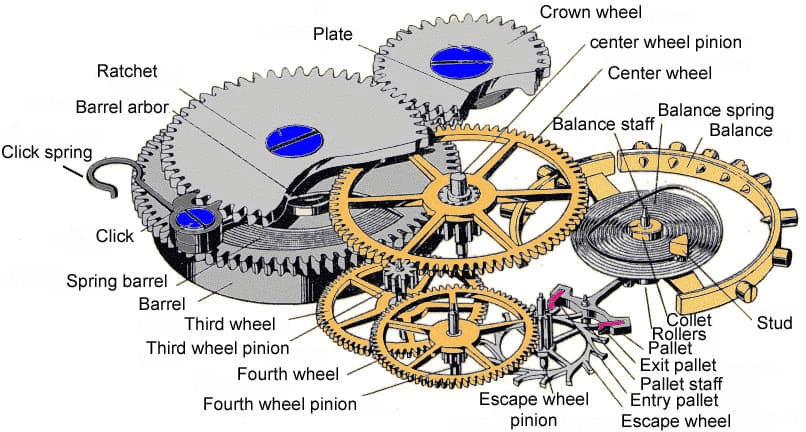
The mainspring’s energy flows through the gear train that transforms the mainspring’s slow, powerful rotation into faster, controlled motion.
This regulated energy reaches the escape wheel, ready for precise timekeeping.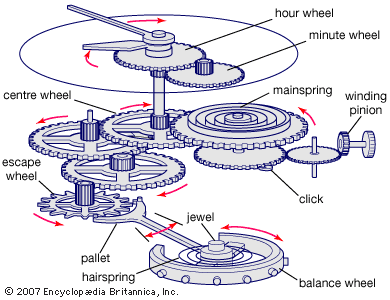
The escape wheel receives all this energy and wants to spin freely. But it can't. It's blocked by the pallet fork.
Since all the gears are connected, this blocks the entire gear train - nothing can move until the pallet fork releases a tooth. But what controls this gate?
Meet the gatekeeper: the balance wheel. This weighted wheel oscillates back and forth, controlled by its hairspring.
Think of it as the watch's metronome - it sets the rhythm for everything else.
Each swing of the balance wheel unlocks the pallet fork to release exactly one escape wheel tooth.
Each release lets the entire gear train advance by a precise amount.
To show time, the gear train connects to the dial train—a separate set of gears (second wheel, minute wheel, hour wheel) under the dial.
These gears convert the gear train’s pulses into the correct speeds for the watch hands:
The second hand sweeps, the minute hand moves 60 times slower, and the hour hand 12 times slower than that, typically through ratios like 1:60:720.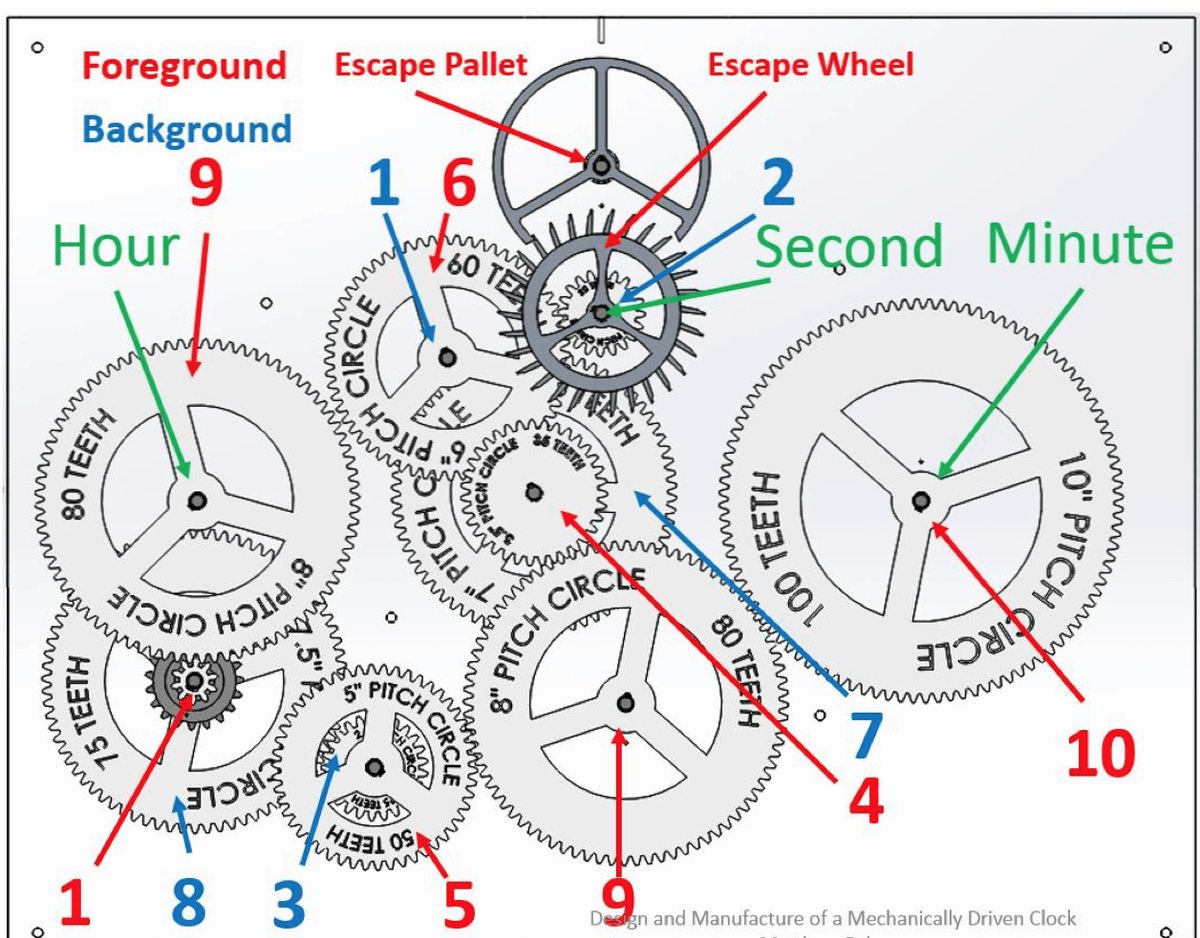
All this precision requires minimal friction.
Jewelled bearings (synthetic rubies) at pivot points let steel shafts spin with virtually no wear.
Those tiny red crystals aren't decoration - they're precision engineering for decades of accuracy.
Those are the basics, but things get interesting with complications.
In watchmaking, a complication is any function beyond basic hours, minutes, and seconds.
These mechanical features require additional gears, springs, and levers - often tripling the component count.
Each complication presents unique engineering puzzles.
I'll cover three of my favourites:
- How do you add a stopwatch without disrupting timekeeping?
- How do you mechanically encode calendar irregularities?
- How do you deal with the effects of gravity?
The chronograph tackles a tricky problem: how do you add a stopwatch without disrupting the main timekeeping?
The solution. A separate gear train runs parallel to the main movement, connected only when needed.
Press start: a clutch wheel drops down, meshing the chronograph train with the main gears. The chronograph hand begins sweeping.
Press stop: the clutch lifts away. The main movement continues unaffected while the chronograph hand freezes.
Reset uses a heart-shaped cam. A hammer strikes this cam, snapping the chronograph hand back to zero through pure geometry.
Multiple hands each get their own gear ratio: minute counter advances every 60 seconds, hour counter every 60 minutes.
Two independent systems sharing one energy source, triggered by button presses while keeping perfect time throughout.
The perpetual calendar is the ultimate challenge, mechanically encoding the Gregorian calendar’s quirks.
A program wheel rotates once every four years (1,461 days), its edges shaped to signal each month’s length.
For 30-day months, a lever advances the date twice on the last day.
February’s 28 or 29 days are tracked by a 48-month wheel, with a feeler lever reading its profile.
Gears with precise ratios sync the day, date, and month, tracking multiple cycles purely mechanically.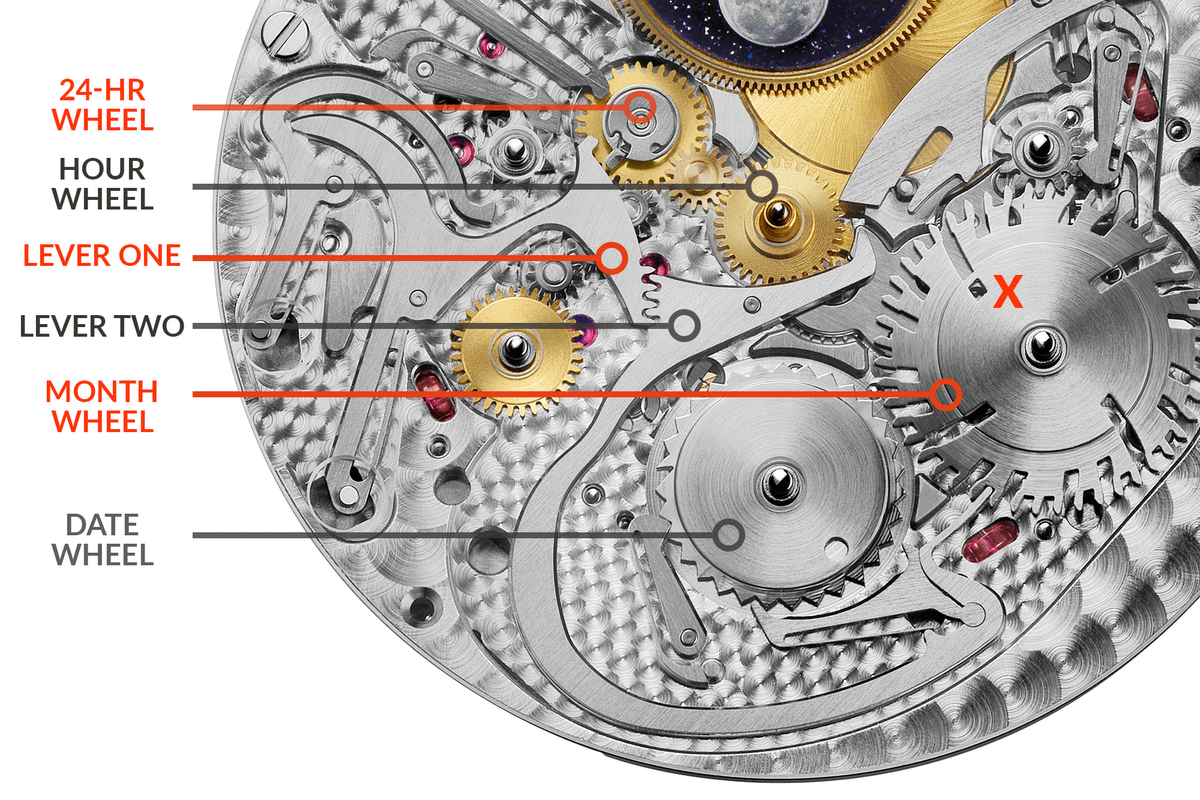
The tourbillon tackles gravity’s effect on timekeeping.
When a watch is vertical, gravity pulls unevenly on the balance wheel, causing timing errors.
The solution? Rotate the entire escapement (balance wheel, pallet fork, escape wheel) in a carriage that spins once per minute, averaging out gravitational errors.
The carriage acts as a gear in the gear train, driven by a fixed pinion.
The balance wheel must be perfectly balanced to avoid centrifugal forces.
In pocket watches, held vertically for hours, tourbillons improved accuracy.
In wristwatches, which move constantly, they’re more about showcasing mechanical mastery.
This is where a few 100 years of mechanical engineering refinement can get you.
No batteries, no electronics, no external power source.
Just human motion converted into measured time.
Now the question is, where will our robots be in 100 years?

Jack 🤖
@JacklouisP
🤖 / acc. I write about robotics @opterantech, we reverse engineer insect brains. Previous - Founder of a robotics R&D agency.