Web3 Terms and Conditions: What terms and conditions are right for the space? A🧵
The only answer is the typical answer that lawyers always give: It depends.
Clearly, whether a project has restrictive terms or CC0 depends on a lot of different factors; however, the NFT community is currently concerned about the terms for NFTiff and Moonbirds
for completely different reasons. It makes sense that everyone is hyperfocused on these issues, but it is difficult for the community to balance both simultaneously.
On one hand, NFTiff's draft terms and conditions that were accidentally uploaded on the "sold out" site, had people worried about traditional companies having terms and conditions that "stole" Punk holder's IP rights through a nonexclusive irrevocable license.
People were understandably worried about this; however, lawyers (well specifically @exlawyernft) knew that this seemed to be a draft and could not be the final terms. After a thread and a DM, the correct terms were re-uploaded and went from: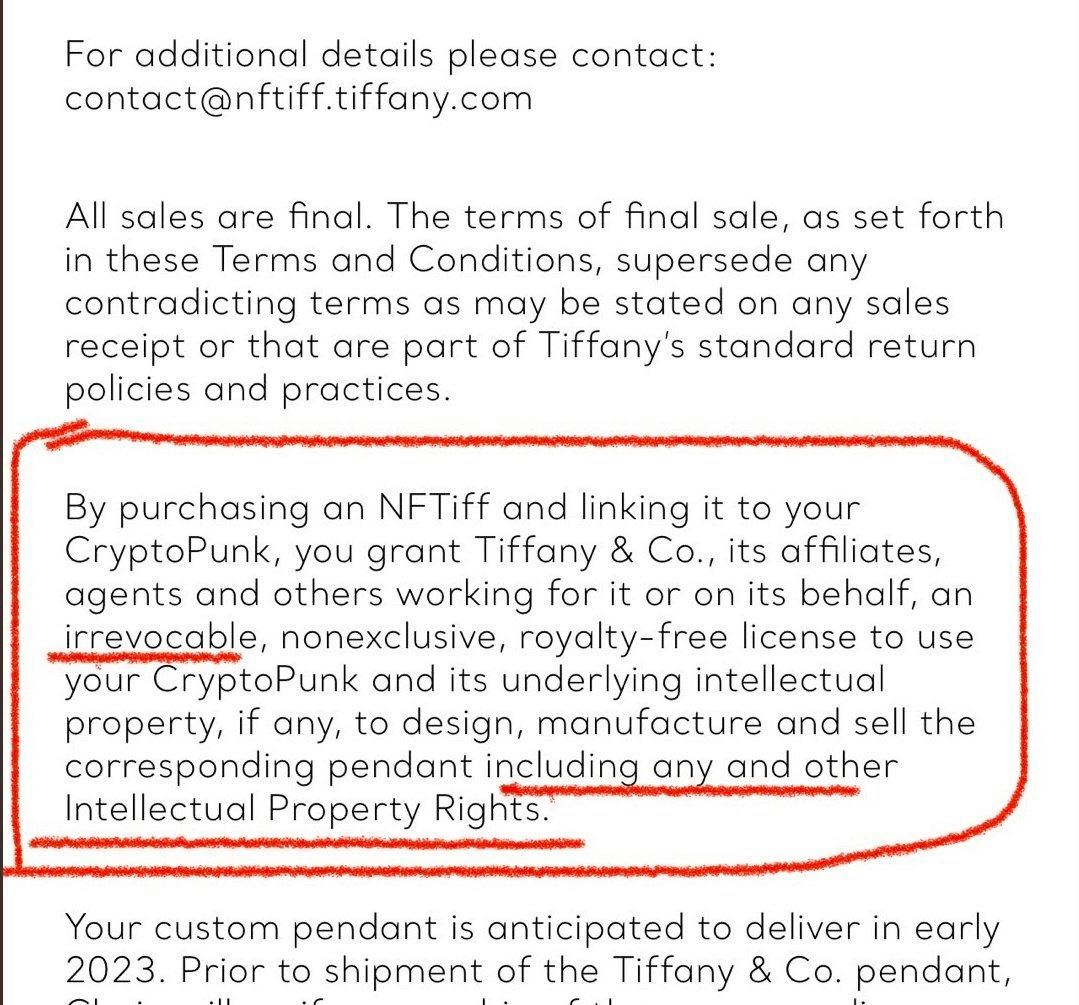
To: "By purchasing an NFTiff and linking it to your CryptoPunk, you grant Tiffany ... an irrevocable, nonexclusive, royalty-free license to use your CryptoPunk and its underlying intellectual property, if any, to design, manufacture and sell the corresponding pendant."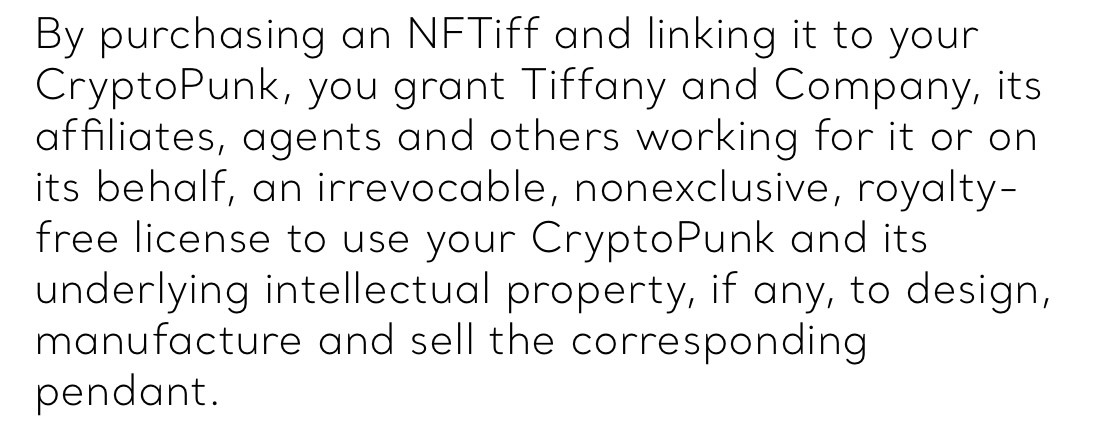
The "including any and other Intellectual Property Rights" was a mistake. The non-lawyer translation is: "you give us a license to use your Punk to make this pendant".
nft.tiffany.com/legal/
Tiffany's isn't going to start using your Punk for advertising or selling Punk pendants to the public. The community was worried about big companies just "stealing" holders' IP rights through legalese and terms and conditions that no one reads.
The correct terms were on the minting site, but only the "sold out" site had the previous draft that was uploaded by mistake.
twitter.com/dt_chain/status/1556026503078494208?s=21&t=UHDNVsEeisHiiuavS6UfFA
On the other hand, with Moonbirds, everyone was surprised by the sudden change to CC0 and felt that holders' IP rights were being taken away too.
Again, this is understandable but PROOF claims they were spending too much time and money on DMCAs and defending their copyright.
It is a difficult balance because while holders are granted licenses, the project has to continue to defend the copyright. When you file a DMCA, you need to be the copyright holder or authorized to act on their behalf.
A license holder is not the copyright holder and may not necessarily be “authorized” to act on behalf of the copyright holder.
So PROOF needs to file the DMCA notices and they most likely use a lawyer to do so.
Let’s assume it takes 6 minutes for a lawyer to file a DMCA notice and charges $500 an hour.
Each DMCA notice would be $50 and PROOF would have to file one for each infringing work.
I do not know how many DMCAs PROOF filed, but clearly, it can get expensive very quickly.
And that does not include demand letters about violations of copyright protections, correspondence, research, and other legal advice.
And this would be for every instance of perceived copyright infringement.
I am not saying what PROOF did is right or wrong. I just wanted to give some perspective on how PROOF was spending a lot of money on legal fees to fight copyright claims.
Both NFTiff and Moonbirds have spurred additional conversations about IP rights and it is exciting to see everyone so interested in a topic I work in!
Usually, my non-lawyer friends do not care about IP rights at all!
These conversations are very important because Web3 is focusing significantly on IP rights so understanding those rights is key!
Make sure you understand what IP rights you are getting or signing away!
These are the people you can expect to write a thread and lead discussions on IP rights and other legal issues on Rug Radio's Law Line with @DeFiDefenseLaw and @GencoLaw.
**This is neither legal advice nor an endorsement. These are merely smart people that are active in the space.**
@DeFiDefenseLaw
@theweb3attorney
@SyedLawTM
@AshKernen
@eliana_esq
@omribouton
@peltzm
@carlosg_esq
@MetaverseLawyer
@BirdnalsNFT
@rothken
@cryptonesy
@ikhanesq
@exlawyernft
@thenftattorney
@KylerW56
@EsqLida
@MattFeinbergEsq
@NeerMcD
@learnedchaos
@lawtoshi
@niftyjawn
@ijhammer
@HalfonJesse
@CarlosDM_Esq
@JeffD_Esq
@sh3k1n4h
Business Development/Legal:
@PabloEnriqueEsq
Resources:
thecod3x.com/
@DAOResearchCo
There are so many great lawyers in this space who love to talk about these topics so please feel free to tag them if I forgot them!
Kevin Kelly, Esquire
@FineArtLawyer
I sued a painting; it was framed. Fine Art lawyer covering classical paintings to NFTs.