Is a banana taped to a wall infringing upon copyright protections of a different banana taped to a surface?!
There’s an ongoing lawsuit over this question so I’ll give my thoughts.
2. Currently, American artist Joe Morford alleges that Italian artist Maurizio Cattelan’s “Comedian” infringes the copyright of his own artistic work, “Banana & Orange”.
Both are clearly bananas taped to a wall using duct tape, but let’s explore the legal side of it.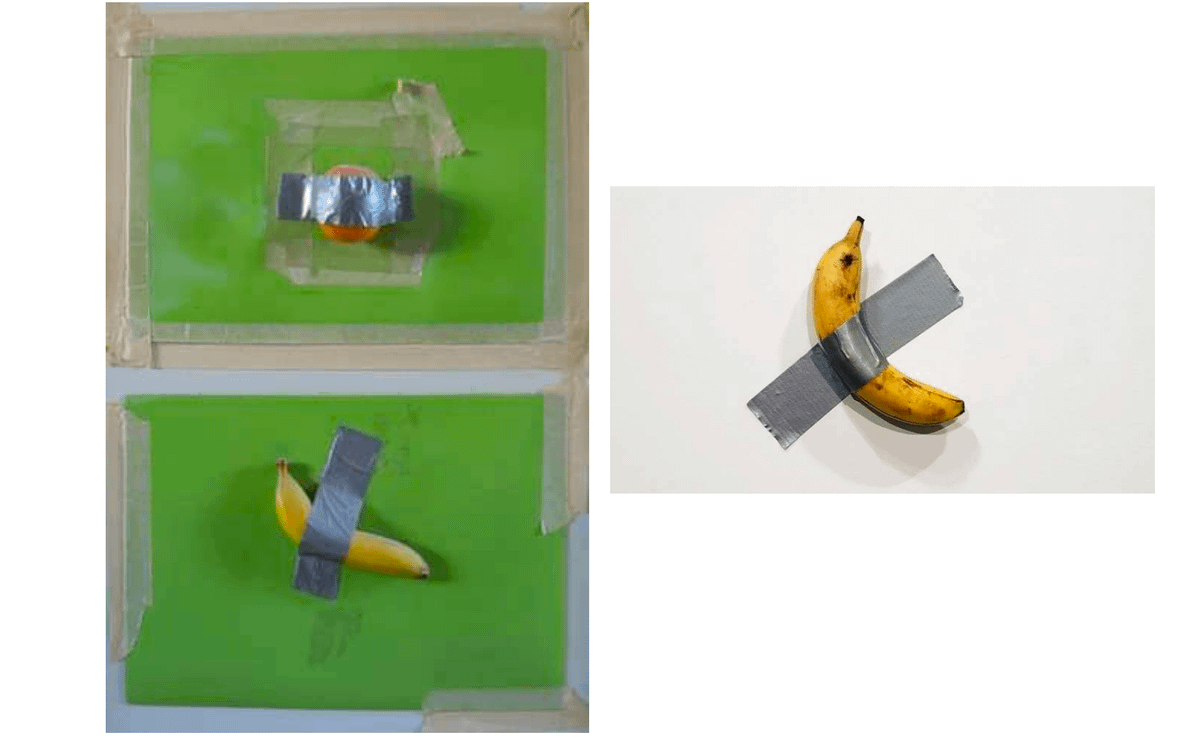
3. You’ll remember Cattelan’s “Comedian” as the work at Art Basel Miami back in 2019 that seemed like a joke and was eaten by a performance artist. Cattelan had the last laugh when the gallery (Perrotin) sold three copies of the work for a total of $390,000 that week.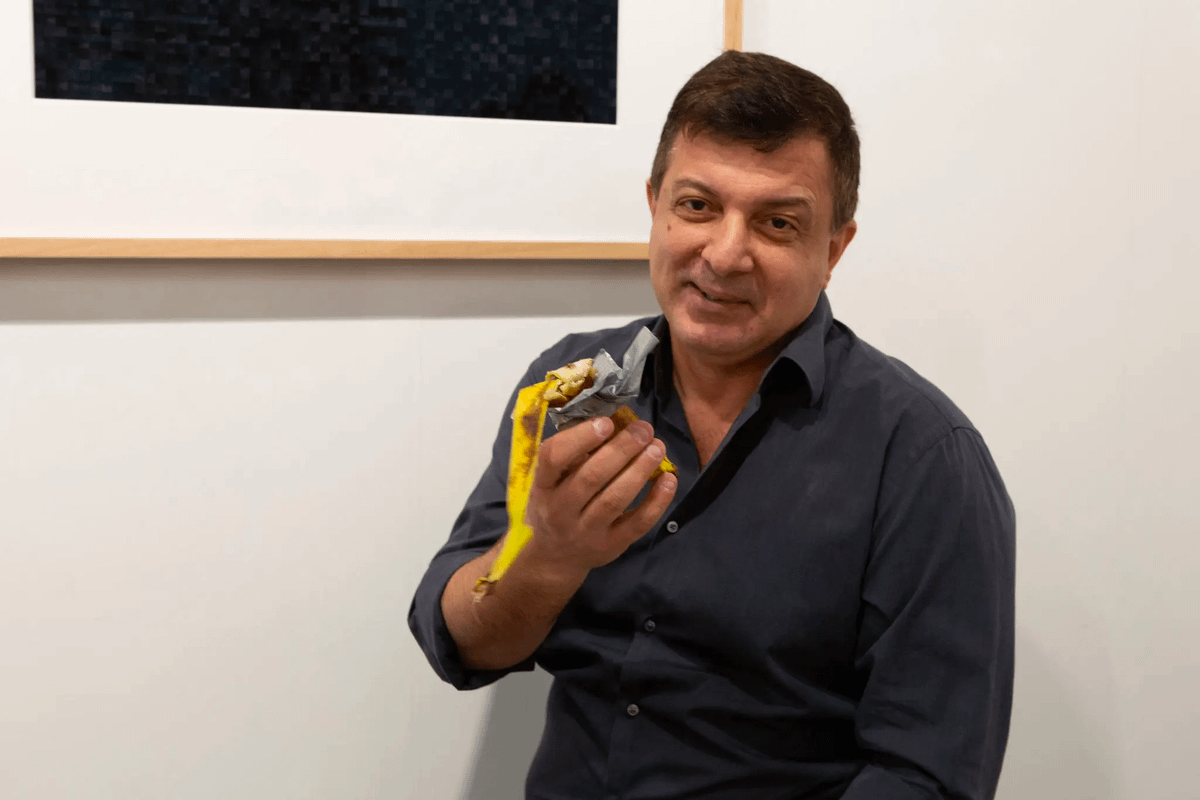
4. Morford, who is currently pro se (legal term meaning he is representing himself), alleges that Cattelan improperly copied his “Banana & Orange” work, which has been registered with the United States Copyright Office since 2000.
5. Both are made with the same medium: bananas and duct tape. Further, both works are arranged in a similar manner; however, Cattelan’s work is clearly missing the orange of Morford’s “Banana & Orange”.
6. United States District Judge Robert N. Scola, Jr of the Southern District of Florida is presiding over this matter and recently denied Cattelan's motion to dismiss the case.
7.I currently have a complex international commercial litigation case before Judge Scola so I know that Judge Scola is a no-nonsense judge. At this stage, Judge Scola thinks that Morford sufficiently alleged that Cattelan's banana infringes his banana.
8. In the background of the Order, Judge Scola remarked, "Thankfully for the Court, the question of whether a banana taped to a wall can be art is more a metaphysical question than a legal one. But the legal question before the Court may be just as difficult -..."
9. "...[D]id Morford sufficiently allege that Cattelan’s banana infringes his banana?"
10. The Legal standard when considering a motion to dismiss under the Federal Rules of Civil Procedure is, if the Court accepts all of the complaint's allegations as true, does the claim demonstrate that the pleader (Morford), is entitled to relief?
11. In considering this, Judge Scola analyzed whether Morford established:
1. Ownership of a valid copyright
2. Copying of constituent elements of the work that are original
12. Copying requires both "factual and legal copying". Basically that the defendant "actually used" the copyrighted work (and may have had access to it) and that the copied elements are "protected expression" such that appropriation is legally actionable.
13. When a plaintiff cannot demonstrate that the defendant had access to the copyrighted work, the plaintiff must meet a higher standard and show tha the works are "strikingly similar".
14. This means that the similarities are so striking that the possibility of independent creation, coincidence, and prior common source are practically precluded.
15. Under the case law, there are a few different tests for courts to determine whether two works are substantially similar; however, Judge Scola sums it up by saying:
16. "Morford must plausibly allege that Cattelan had access to Banana & Orange and that—after dissecting Banana & Orange and stripping (or filtering) away the non-protected elements of it—there is a substantial similarity between the two works."
17. While Judge Scola ultimately observed similarities for purposes of the motion to dismiss, the ultimate decision is left to the trier of fact.
18. On the first prong (whether a valid copyright exists), Judge Scola held that the Mordford's Banana & Orange was absurd and farcical, it met the minimal degree of creativity needed to qualify as an original.
19. On the second prong (copying), Judge Scola held that while Morford cannot claim a copyright in bananas or duct tape, he may be able to claim that he had some degree of protection in the "selection, coordination, [and] arrangement" of these otherwise unprotectable elements.
20. When determining copyright infringement, the courts also look to the extent of copying with respect to "both the quantitative and the qualitative significance of the amount copied to the copyrighted work as a whole."
21. Judge Scola held that the banana and duct tape are both quantitatively significant and qualitatively significant in "Banana & Orange"; therefore, the alleged infringement of Mordford's banana is sufficient to state a claim.
22. This does not mean that Morford wins. This just means that the Court is going to allow discovery and hear more about this alleged copyright infringement.
23. What do you think? Can a banana and duct tape be “art”?
Is taping a banana to a wall sufficiently original and creative?
Is it possible that Morford and Cattelan came up with the idea independently of each other?
@EsqLida @NeerMcD @BirdnalsLAW @eliana_esq @exlawyernft
Kevin Kelly, Esquire
@FineArtLawyer
I sued a painting; it was framed. Fine Art lawyer covering classical paintings to NFTs.