
(1/8) Computer Science Basics: Vectors
Vectors are a mathematical primitive that turn out to be particularly useful in computer science. In order to understand modern cryptography (and other advanced computational applications), you need a good grasp on this foundational topic.
(2/8) A vector is a concept used to convey quantities that cannot be expressed by a single number.
Think about velocity, which is a mathematician's way of saying "speed plus direction."
Speed is 10 m/s. Velocity is 10 m/s in a north-west direction.
(3/8) Vectors are incredibly versatile and show up again and again across mathematics.
There are many different ways to express a vector, each having their own benefits and drawbacks. Here are just a few of the ways we can express the same information.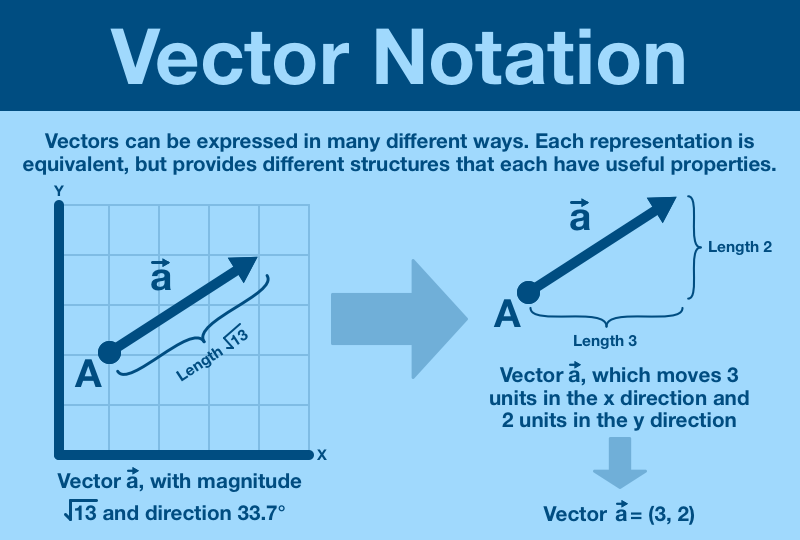
(4/8) First we looked at a single-dimensional vector (tweet 2) and a 2-dimensional (tweet 3). Below is an example of a 3-dimensional vector.
This is as far as the human brain can visualize, but mathematical dimensions can continue far beyond 3; they can go arbitrarily high.
(5/8) A vector in n-dimensional space can hold up to n data points, one piece of data in each dimension.
The easiest way to see this is in the (v_0, v_1, ... , v_n) notation. Each dimension provides capacity to store an extra point of data.
(6/8) Now you might be asking yourself "ok, I understand that we can put data into a vector, but why would I want to?"
Remember, vectors are mathematical primitives. They are incredibly powerful because they can be programmatically manipulated.
(7/8) Think about 3D space, a vector just looks like an arrow.
Take two arrows, place them tip-to-tip. Draw a new arrow from the start of the first one to the end of the second. You've just done vector addition!
(8/8) This is the end of our short intro to vectors.
For now, all you need to remember is simple: vectors allow us to store an arbitrary amount of data in a way that can be mathematically manipulated.
Now let's go look at where we see them in use!