Would you rather find $20 or not lose $20?
Seems odd right? What if I told you the pain of losing $20 is psychologically twice as powerful as the pleasure of finding $20. This concept is known as Loss Aversion, and it could be holding you back.
1/30 🍑🧵
In this thread we’re going to look at 1) what is loss aversion? 2) the psychological factors behind WHY it happens, 3) individual and systemic examples of loss aversion, and 4) how you can avoid loss aversion to improve your investment decisions
2/30
So, what is loss aversion?
Loss aversion is a cognitive bias that describes why the pain of losing is psychologically twice as powerful as the pleasure of gaining. I.e., losing half your investment in $CUM coin feels twice as bad as doubling it feels good.
3/30
Now that we know what loss aversion is, why does it happen? Our neurological makeup, socioeconomic factors, and cultural background all contribute to loss aversion in distinct ways.
4/30
Let's start with our monkey brains. In instances involving loss aversion, two distinct areas, let's call them "light strings", of our brain (see the GIF below if you want to understand why), start lighting up more than your grandma's tree on Christmas eve.
5/30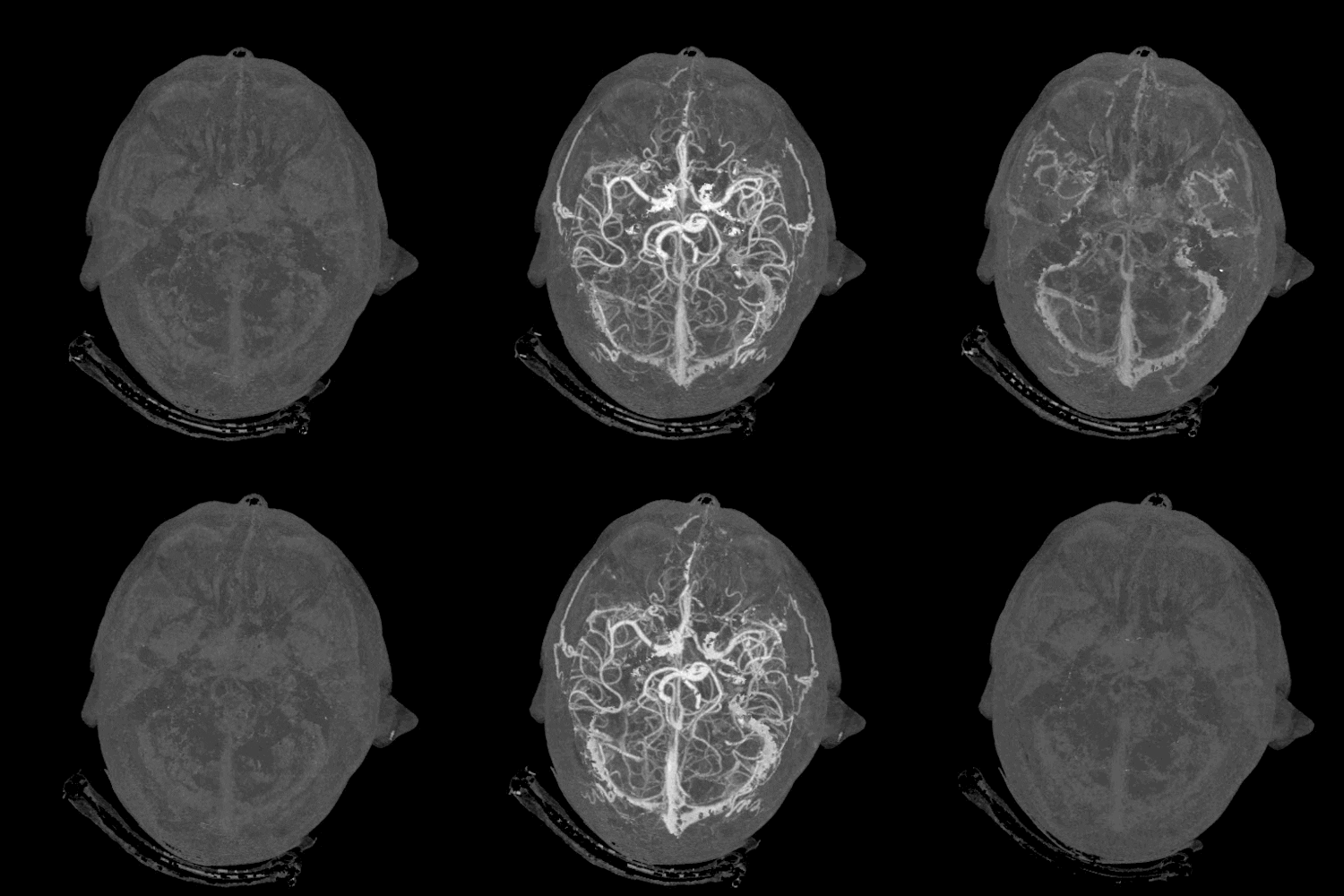
Light string # 1 is the amygdala. The amygdala is the emotional control center of our brains that deals with fear. When you see a watersnake swimming toward you (sorry for that visual) the amygdala lights up and produces a pre-conscious fight-or-flight anxiety response.
6/30
When we lose money, the same amygdala that just lit up and shit itself at the sight of the watersnake lights up in the same way. This indicates that both fear and loss can trigger the exact same sense of anxiety and fight-or-flight.
7/30
Light string # 2 is the striatum. One of the many things the striatum does is coordinate reward perception. When we lose $20, the striatum lights up twice as bright as when we win $20. Let me repeat that. The same dollar amount but twice the brain activity when we lose it!
8/30
Socio-economic factors also play an essential role in one's disposition to loss aversion. High net worth individuals are generally less loss-averse than low net worth individuals. If you had $100 in the bank, losing $50 will sting a lot more than if you had $1,000,000.
9/30
Cultural differences between collectivist and individualistic societies also play a role. Individuals from collectivist countries such as China and Brazil are less loss-averse than their counterparts from individualistic countries such as the USA, Canada, and Germany.
10/30
Individuals from collectivist societies are more likely to have stronger and tighter social connections, implying that if they make a bad decision and suffer a loss, they would be supported by their friends, family, and community.
11/30
Individuals from these collectivist countries are therefore able to take chances without experiencing as many setbacks because of this support structure.
Where do we see examples of loss aversion in the real world?
12/30
1 - Insurance
Loss aversion is the bread and butter of the insurance industry. The insurance business model relies entirely on people's need for security and their desire to avoid risk and loss, no matter unlikely that loss would be.
13/30
What do you see when you scroll through an insurance website?
A massive list of highly unlikely and costly outcomes that individuals may encounter if not insured. These lists prime us to recognize the potentially massive financial losses of being uninsured.
14/30
By highlighting these potential losses, individuals are more than willing to ignore the comparatively small monthly premium to be insured. Loss-aversion can explain the need to commit to an insurance plan, even if the losses listed are unlikely to occur.
15/30
2 - Pest control
Weird example right? Let me explain.
When Brazil was afflicted with mosquito-borne Zika and dengue fever, the Brazilian gov't engaged a company called @Oxitec to tackle the problem. They came up with a brilliant but risky solution.
16/30
@Oxitec genetically engineered and bred mutant mosquitoes that would give birth to all-male, non-biting, and self-destructive progeny. This novel approach was extremely risky for Brazil to undertake, one which would have cost the country millions if not successful.
17/30
The program was a massive success. It reduced mosquito larvae by 82% and decreased the prevalence of dengue fever by 91%. If the country’s epidemiologists and politicians had had a higher level of loss aversion, they might have never discovered this revolutionary solution.
18/30
Unfortunately, more risk-averse nations, such as European countries, continue to lag in comparison to regions like South America and China. In the agricultural sector, Europe usually takes a more conservative approach with risk-averse regulations.
19/30
This loss aversion in decision-making bodies may prevent European countries from trying new emerging technologies for fear of risk and loss. Furthermore, it leads European countries to prefer less effective and less eco-friendly pest control options like insecticides.
20/30
3- Financial risks
What about the investment world?
Using what we've learned about loss aversion so far, it can be assumed that an investor will more heavily weigh potential losses and failures than potential gains.
21/30
For what it's worth a lot of us DeFi degens may have the opposite problem but that's a thread for another day...
22/30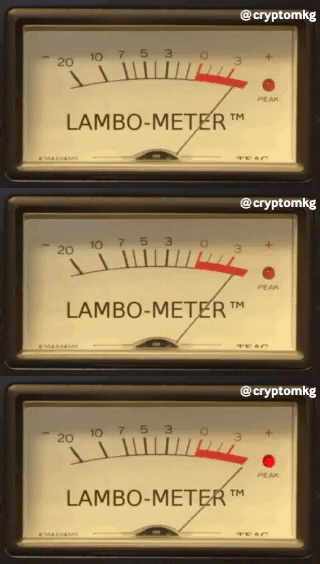
When making an investment decision, one usually focuses on the risks associated with the investment rather than the potential rewards. A common philosophy among stock traders is that once you sell a stock, you should stop putting energy into tracking it.
23/30
This is because many people become hyper-focused on investments that lose money, ignoring investments that make money.
This obsession with avoiding losses becomes apparent when deciding whether to sell a token at a lower price than you bought.
24/30
People may not be willing to make this financial decision even if selling is the best option at the moment. Selling the token means realizing a loss and we hate realizing a loss far more than we enjoy realizing a gain. #HODL
25/30
Now we know what loss aversion is, why it happens, and where it happens in the real world. This leaves the little nugget of a question "how do we avoid it?"
Let me give you two key strategies that have helped me immensely:
26/30
1 - Framing
The way a decision or choice is framed greatly influences the perception of loss aversion. Instead of saying to yourself "if I sell now I lose 20% of my investment", frame it as "if I don't sell now I will lose 90% of my investment" (extreme example).
27/30
2 - Perspective shift
"What's the worst that could happen?"
This is the simplest and easiest mental trick to tackle loss aversion. By forcing yourself to think about the worst possible outcome you can better rationalize if it’s worth making a decision or not.
28/30
I wanted to give a huge shout-out to @TheDecision_Lab for their amazing article that inspired this thread. Check it out here: thedecisionlab.com/biases/loss-aversion
29/30
For an overview of cognitive biases in investing check out this dope thread by @thedefiedge. I will be doing in-depth breakdowns of many of these biases in future threads so let me know what ones you would like to see!
twitter.com/thedefiedge/status/1490765231248838661?s=20&t=LhWPKWCVLxW07g7l72gtVw
30/30

Naive Nectarine 🍑
@NaiveNectarine
Just a guy with an above average interest in psychology, mental health, & DeFi