🚨New Paper Announcement🚨
We have successfully performed EPR DEER at biologically relevant concentrations with the self-resonant microhelix at X-band using less than 1 mW incident power! This leads the way for low cost desktop pulse EPR instruments. 🧵
doi.org/10.1039/D1CP05508A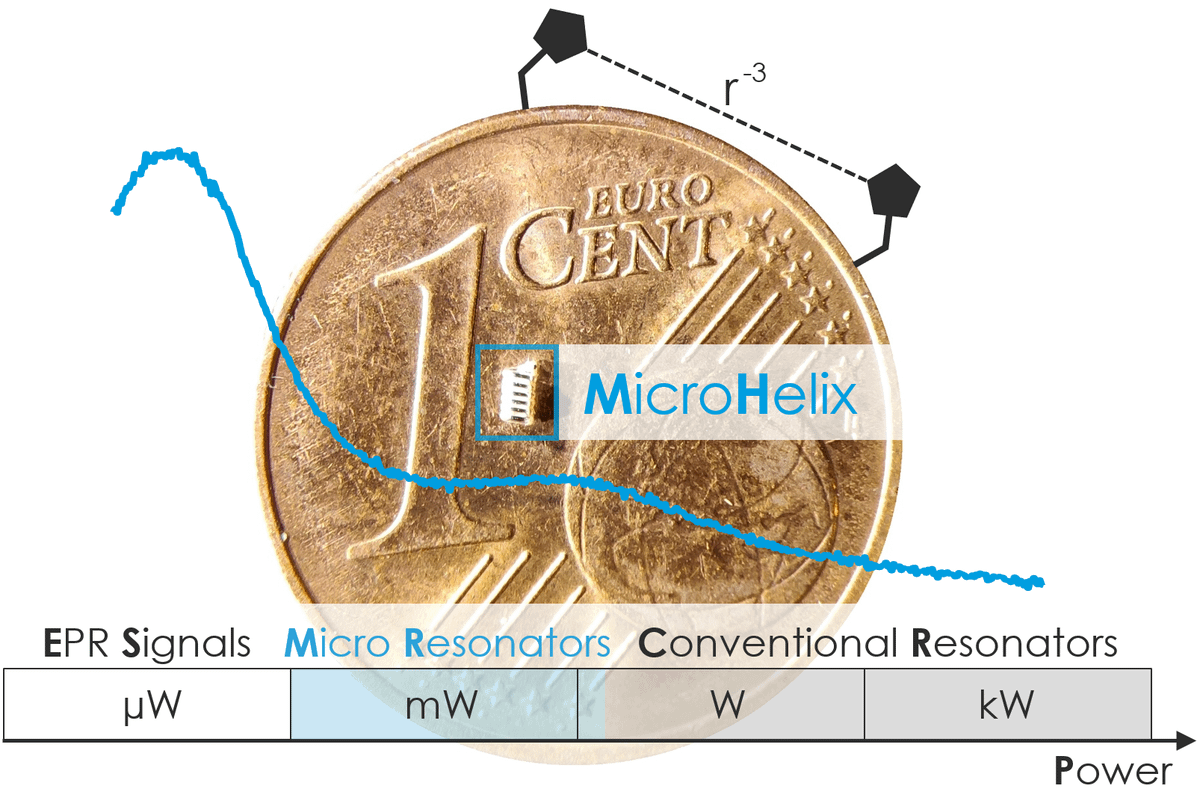
First, the volume of the microhelix is 85 nl, which is 117x less volume than the commercially available loop-gap resonator (10 ul) but our concentration sensitivity is only 11x lower! This is due to the 3D geometry of the helix, where we gain by 6.5x which is the number of turns.
We also gain a sqrt 2 in sensitivity because the self-resonant microhelix bandwidth critically coupled (~90 MHz) is sufficient to perform most EPR pulse experiments without overcoupling.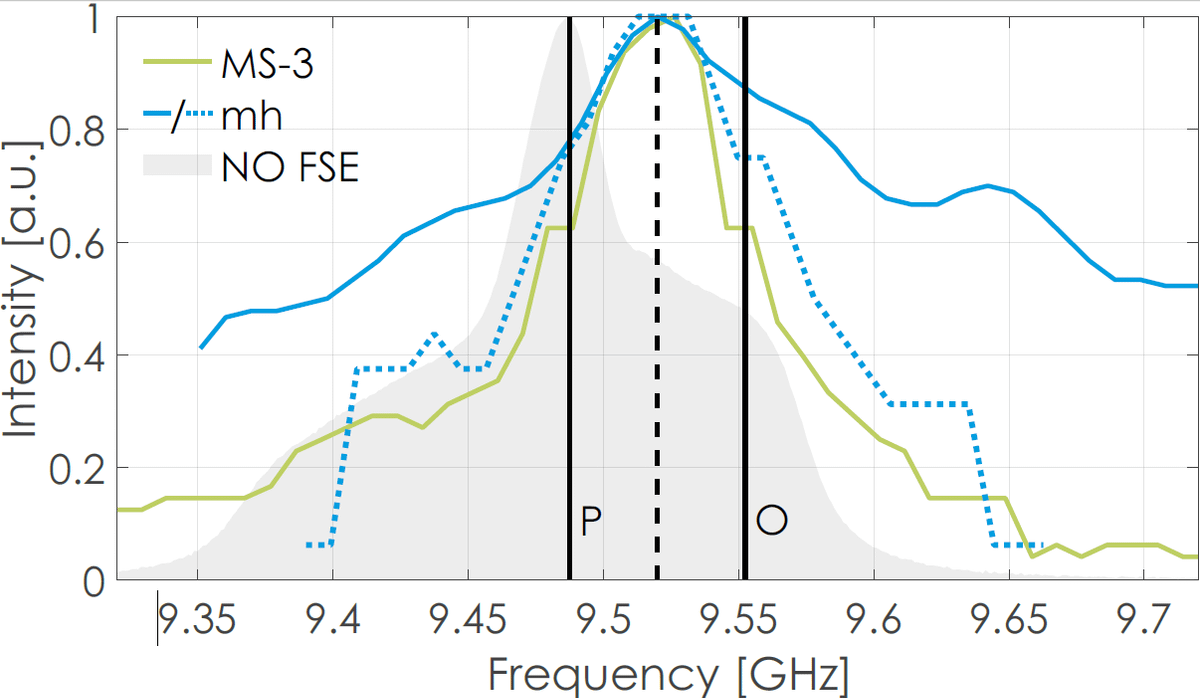
This is in contrast to planar microresonators which are typically on PC board substrates and have 1 turn, poor microwave field (B1) homogeneity over the sample, and further reduced volume.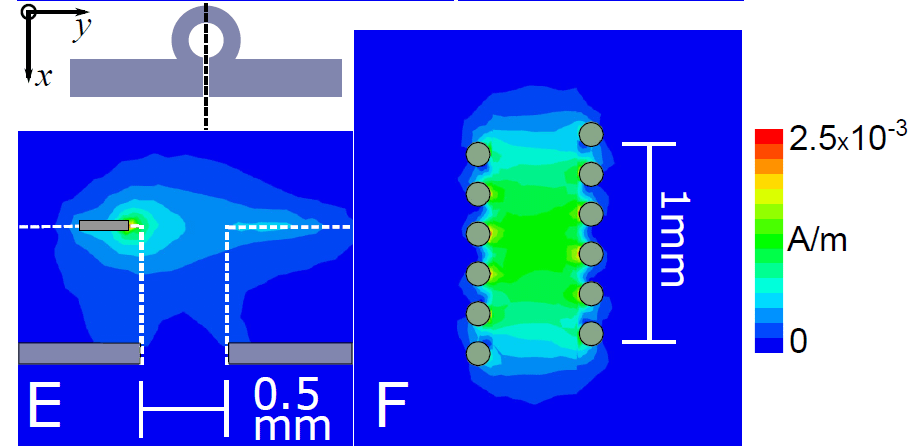
Second, the low Q-value of the microhelix significantly reduces the ringdown of the resonator, while the high microwave efficiency (3.2 mT/sqrt(W)) reduces the required power (<650 mW 14 ns pi-pulse) and deadtime is reduced. We measure pulse-to-pulse deadtimes of 12 ns! A record!
With low deadtimes, we can revisit the 3-pulse DEER sequence and find the t=0 by implementing the DEER-Stitch method pioneered by @SpinLovett This work only needs a very short 4-pulse DEER trace. Using rmsd of the pulses we remove a priori requirements, increasing robustness.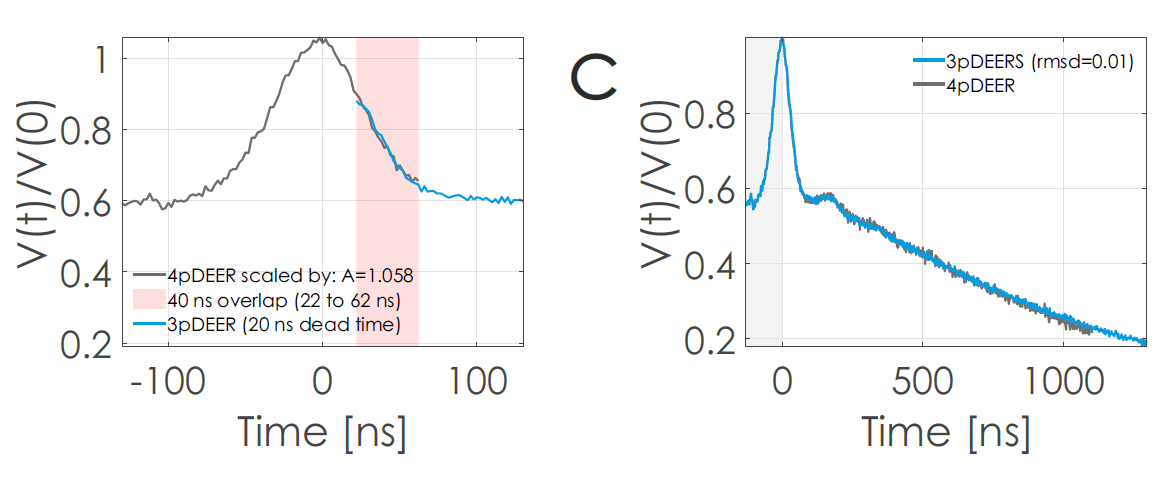
The 3-pulse DEER buys us a factor of 2 in sensitivity due to the EPR signal dependence on Tm, but also opens the door for fast relaxing spin species. For simplicity, we test this by making DEER measurements at 50, 80, and 100 K. Tm of 1, 0.9 and 0.7, respectively.
To me, this is very exciting work and shows the direction I am going with my research *ahem, cough* FID *ahem*. I really have to thank @markus_te for all the time and work he put into this paper and MPI-CEC (@mpicec_press) and Alexander Schnegg for extending my short postdoc.
And as a sneak peak... I've been at the Department of Biophysics @MedicalCollege already closing the gap between the self-resonant microhelix and commercially available resonators. Concentration sensitivity isn't so far out of reach. More to come!
Jason W. Sidabras
@ActEPR
Physicist/Humanist doing magnetic resonance research with emphasis on instrumentation development to study enzymes. #SingleCrystalEPR Views are my own. (he/him)